Alexander Arutiunian died at the age of 91, March 28, 2012, in Yerevan, the city of his birth. If Armenia does not immediately summon up a litany of recognisable Western composers, Arutiunian was, for 60 years, a distinctive and internationally recognised figure from the South Caucasus. Underpinned by the pedagogical traditions of the Soviet era and fuelled by the proud identity of Komitas as the spiritual father of Armenian classical music, Arutiunian’s evocative, resourceful and attractive musical language took flight.

From his early cantata, Motherland, of 1948 (for which he won the Stalin Prize ahead of Shostakovich) to his final piece in 2011, a flute concerto, Arutiunian explored ways of harnessing intensity of emotion within established classical forms, flavoured variously with regional characteristics. Early works draw on indigenous improvisatory models whilst his opera Sayat-Nova (1967) celebrates the Armenian troubadour (or ‘meistersinger’) in the time-honoured romantic ideal of vernacular minstrelsy. However his catalogue is largely focused on a repertoire of idiomatic instrumental works, most notably well-crafted concertos for all the members of the brass family.
If there is a single work which captivated audiences and critics alike it was the Violin Concerto, Armenia-88, inspired by the Spitak earthquake of that year, which killed 25,000 people at the height of the Soviet ‘stagnation era’. The concerto reveals Arutiunian at his most profound, personal and coherent. It was described by Joseph Horowitz as a work which ‘overflows with graceful melodic invention, rhythmic vitality, deeply felt emotional intensity and dionysiac exuberance’.
Yet it is his Trumpet Concerto of 1950 which has established Arutiunian’s name as a durable figure. There is no conservatoire in the world in which this work does not feature perennially in syllabuses, competitions and concert programmes. It is arguably the best-known trumpet concerto after the Haydn and the Hummel. Like those two pioneering works, Arutiunian alights readily on the most naturally vocalised and lyrical qualities of the trumpet whilst also exploiting the instrument’s dynamic articulation in thrilling figuration and a dazzling culminating cadenza.
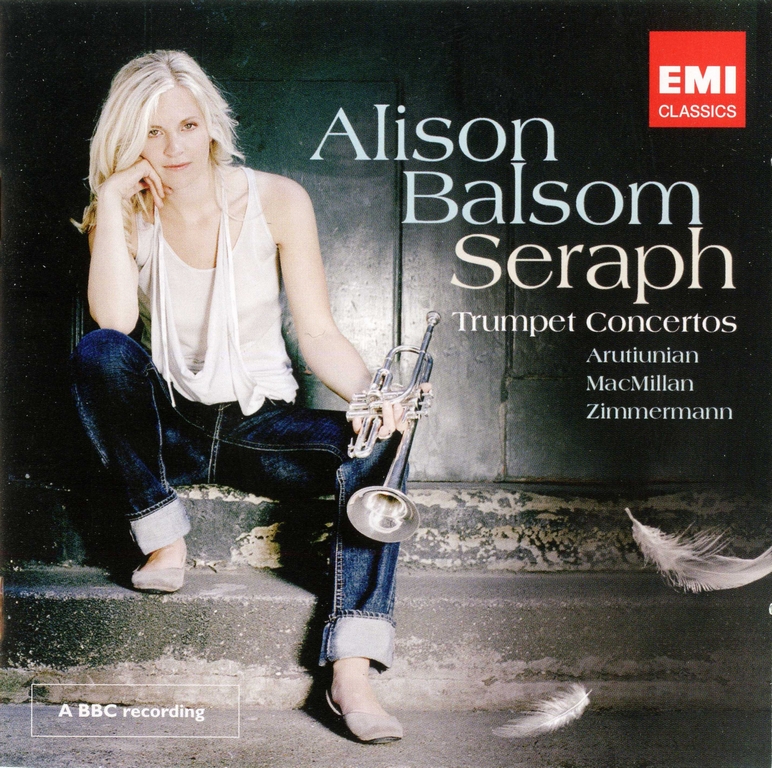
Whilst it has been suggested that the work suffers from derivative and nostalgic Russian gestures (including a delightfully Polovtsian middle section), the rich melodic character, taut structure and generosity of spirit have ensured that it remains a central work in the armoury of every self-respecting solo trumpet player. It was most famously recorded by Timofei Dokschitzer with the Bolshoi Theatre Orchestra under Gennadi Rozhdestvensky but since then has been recorded by fine players from Maurice André to Alison Balsom. --Gramophone Magazine, May 2012