Hiển thị các bài đăng có nhãn Compilation Baroque. Hiển thị tất cả bài đăng

Thứ Hai, 23 tháng 9, 2013

The Musical Treasures of Leufsta Bruk II


In the 18th century, Leufsta Bruk – some 140 kilometres northwest of Stockholm – was the centre of a major industry producing iron both for Swedish needs and for export. It was a little principality in the middle of the forest governed by the descendants of Louis De Geer, the Belgian financier who had developed the ironworks. Highly cultured and musical, the family gathered together a remarkable collection of musical scores, a collection which mirrors the development of music and music publishing on the Continent, as well as the musical activities at a flourishing Swedish manor of the period.


Presenting a sample from the Leufsta collection, this disc contains music by international stars – Tartini and Handel – as well as less familiar names, such as the London-based German composer Gottfried Keller and the Swedish composers Johan Helmich Roman and Hinrich Philip Johnsen. Concertos, keyboard solos, sonatas and duets bear testament to the entertainments – often with the active participation of members of the De Geer family themselves – that enlivened the evenings at Leufsta in the mid-18th century. The programme closes with music that has a special connection to the church of Leufsta Bruk and its famous organ from 1728: excerpts from Johnsen’s Church Music, composed for the Easter Day service of 1757.

Bringing these musical treasures to life is the Drottningholm Baroque Ensemble, whose many recordings on BIS have created a following around the world. Released in 1985 their version of Vivaldi's Four Seasons, with soloist Nils-Erik Sparf, is still considered one of the classic recordings of this work. More recently the forerunner of the present disc (Musical Treasures of Leufsta Bruk I, BIS-CD-1526) was described as a ‘superbly performed … unique collection of pieces demonstrating an eclectic and aristocratic taste of the early 18th century’ by the reviewer on the website MusicWeb International.

Thứ Tư, 18 tháng 9, 2013

The Musical Treasures of Leufsta Bruk I


In the 18th century, Leufsta Bruk – some 140 kilometres northwest of Stockholm – was the centre of a major industry producing iron both for Swedish needs and for export. It was a little principality in the middle of the forest governed by the descendants of Louis De Geer, a Belgian financier who developed the ironworks. The family was highly cultured and musical, and in particular Charles De Geer, a noted scientist as well as industrialist, contributed greatly to the remarkable collection of musical scores at Leufsta. These scores were to a large extent brought from Amsterdam and mirror the development of music and music publishing on the continent, as well as the musical activities at a flourishing Swedish manor of the period.


Not surprisingly the collection – and this disc – contains music by well-known composers such as Vivaldi and Tartini, but there are also rarely heard works, for various instrumental combinations. Duets, keyboard solos, trio sonatas and the charming collection of ‘Boer Dances’ bear testament to the entertainments – often with the active participation of members of the De Geer family themselves – that enlivened the evenings at Leufsta in the mid-18th century.

Bringing these musical treasures to life is the Drottningholm Baroque Ensemble, whose many recordings on BIS have created a following around the world. Released in 1985 their version of Vivaldi's Four Seasons, with soloist Nils-Erik Sparf, is considered one of the classic recordings of this work. A much later disc, Telemann’s Don Quixotte (BIS-CD-1226) was recommended by the Spanish magazine CD Compact, and received a 5 star review in BBC Music Magazine, containing the following words of praise: 'the Drottningholm musicians capture all with admirable esprit and no breaches of stylistic decorum.' The same may safely be said about the present recording.

Thứ Bảy, 14 tháng 9, 2013

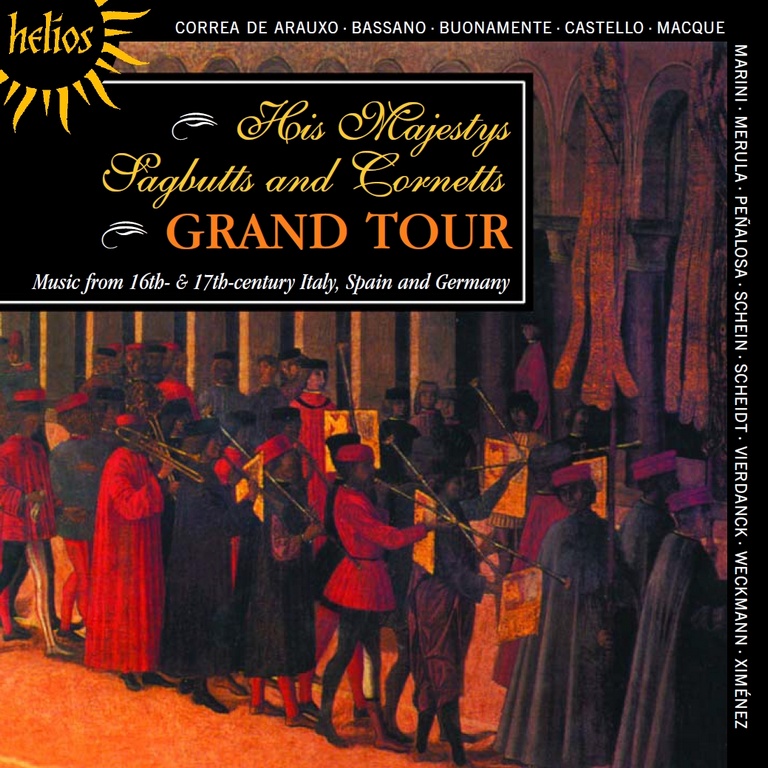
His Majestys Sagbutts and Cornetts Grand Tour


'Very stylish and well-informed performances of some fascinating repertoire' --Classic CD

'This is everything a grand tour should be: educating, entertaining and enriching. Well worth exploring' --BBC Music Magazine

'A strong recommendation' --Gramophone

'A thoroughly recommendable issue' --Fanfare, USA


This is the first record in a projected series on Hyperion by His Majestys Sagbutts and Cornetts. The works featured comprehensively survey the remarkable repertoire composed over two hundred years in Italy, Germany and Spain and reveal an astonishing breadth of atmosphere. The musical pomp and splendour of bygone royal ceremony can be answered by the most tender and delicate of chamber music: all legitimate repertoire for what was in the past recognized as the most versatile of all instrumental ensembles.

Italian Virtuosi of the Chitarrone


The chitarrone is one of the more spectacular instruments of the early baroque. The name probably means ‘large kithara’, after the instrument played by the Classical Greek poets, and it was first developed as a bass lute to accompany singing and recitative Between 1604 and 1640, Giovanni Girolamo Kapsperger (also known as Johann Hieronymus Kapsberger), Alessandro Piccinini and Bellerofonte Castaldi published a number of collections of chitarrone music, from which Jakob Lindberg has chosen some favourite dances, arias, toccatas and passacaglias.


Combined into seven suites, they provide rich opportunity to enjoy the particular timbre and the special playing techniques of this instrument.

Jakob Lindberg has a long-standing interest in the many varieties of lutes and has now dedicated himself to researching their relative – research which informs both the performances and Lindberg’s own liner notes.

Thứ Bảy, 31 tháng 8, 2013

A Noble Entertainment


The young, vibrant musicians of The Parnassian Ensemble spotted a gap in the early music market and have filled it with flair, producing a debut album of original music for two recorders and continuo from the time of Queen Anne, most of it not previously available on disc. The only ensemble in England concentrating on this repertoire, the Parnassians relish in introducing to audiences this fine, original, early eighteenth-century English recorder music which would otherwise remain virtually unknown. 


The enthusiastic reception led them to commit their expertise to disc. Since its formation in 1998, The Parnassian Ensemble has gained a reputation for its virtuostic performances and innovative programming.

Thứ Bảy, 13 tháng 7, 2013

Spanish Dances: Selections from Ruiz de Ribayaz's 'Luz y Norte'


“Concerts with The Harp Consort have the spontaneity of improvised jazz and the perfection of state-of-the-art Early Music… a stupendous mixture of historical accuracy and improvisatory freedom… breaking the concert mould… Music-theatrical fascination… gypsy dances… Spanish Humour… French elegance… thrilling …a magical collage of text, sound and dance: The fabulous Harp Consort” -- Frankfurter Allgemeine, Rundschau, Neue Presse & Main-Ech


Thứ Sáu, 21 tháng 6, 2013

Francesca Caccini: Sacred & Secular Songs


Francesca Caccini (no relative of the male composer with the same name) was a remarkable composer, singer, lutenist and poet in the Italian Baroque, serving at the prestigious court of the Medicis. She was a celebrated soprano, wrote a full scale opera and excelled in her own works. This recording features sacred and secular songs, music of deep emotional impact, dealing with the joys and sorrows of earthly and heavenly love.

New recording with the celebrated Italian soprano Elena Cecchi Fedi, accompanied by a colourful and rich instrumental group featuring cittern, theorbo, viola d’amore, guitars and strings.


Francesca Caccini was certainly an exceptional woman. Not only was she a 'diva' of the Baroque world who had the voice 'of a nightingale', but she was also a lutenist, poet, and the first ever female to compose a full-scale opera (La liberazione di Ruggiero). She first rose to fame at just thirteen years old when she performed in scenes of Peri's Euridice to widespread acclaim, earning the nickname 'La Cecchina' (Little Francesca) by which she would be known for the rest of her life.

The songs in this collection would more than likely have been performed by La Cecchina herself at the Medici court, where she was employed as a musician, and many are representative of her florid style of composition; Caccini was known to be meticulous in the notation of her works, ensuring that each emphasis, syllable and melisma fell in exactly the right place. Fluid melisma and ornamentation are indeed characteristics of the works O vive rose, Non so se quel sorriso and Ch'Amor sia nudo, with those of the latter offset by lilting dance rhythms in the accompaniment. However, these are a stark contrast to the penitent Maria, dolce Maria, and pensive Dov'io credea. A highlight of the recording is undoubtedly Lasciatemi qui solo, a dramatic jewel, in which a lamenting vocal line and false relation in the accompaniment are joined by a mournful, singing theorbo part. These songs are just a glimpse of the skill and versatility of this special composer.

Soprano Elena Cecchi Fedi has performed in concert halls and festivals throughout Europe and has made several recordings. She is joined by the critically-acclaimed lutenist and theorbist Gian Luca Lastraioli, whose career has allowed him to appear in some of the most prestigious performance venues around the world, and who directs the Cappella di Santa Maria degli Angiolini on this recording.

Thứ Ba, 16 tháng 4, 2013

Eleven-String Baroque


A world-class musician, classic repertoire, and a recording team that knows how to maximize studio conditions to produce a CD that's faithful to all concerned--that's what we have in this expertly programmed, masterfully performed, sensitively recorded recital by Swedish guitarist Göran Söllscher. The music consists of works Söllscher has performed often in concert but has never recorded--and we are the beneficiaries, enjoying the interpretive payoff resulting from the soloist's considerable experience with these pieces.


And the musical riches are substantial, from Bach's Sonata No. 1 (a Söllscher transcription of the solo violin sonata BWV 1001) to the suprisingly sophisticated and engaging Pachelbel Suite (originally for lute). Also notable are the melodious Andante by Johan Helmich Roman, the sweet and gentle Aria by Ernst Baron, the pleasingly familiar transcription of Bach's Menuet in G (from the Anna Magdalena Notebook), and the fresh rendition of the "Air" from Bach's D major orchestral suite (the infamously titled "Air on the G string"), which in Söllscher's hands comes off as a stately dance.

You can't ask for a performer more in touch with his repertoire or his instrument, in this case an 11-string guitar that possesses an impressively vibrant, resonant voice and is capable, thanks to Söllscher's technique and stylistic mastery, of limitless expressive range. And throughout, we hear every line clearly articulated and properly weighted according to context. It's a pleasure to hear such confident, assured playing, infused with what we can only conclude must be sheer joy felt by a musician performing some of his favorite pieces. Some listeners may find the sound too close and Söllscher's instrument unrealistically huge--but I found it invigorating and absolutely correct for conveying the personality of Söllscher's guitar and affording uninhibited access to the depth and detail of these engaging works. A pleasure. [9/10/2004]  --David Vernier, ClassicsToday.com


Thứ Sáu, 29 tháng 3, 2013

The Trio Sonata in 18th-Century France


London Baroque presents a disc charting the Trio Sonata in 18th-century France - a musical environment undergoing rapid changes following the death of Louis XIV in 1715.

In 1725 François Couperin published his Apothéose de Lulli, advocating a fusion of Italian and French styles, and the following year saw the collection Les Nations, which included L’Impériale recorded here.


Jean-Marie Leclair and his colleague (and great rival) Jean-Pierre Guignon took the idea one step further. Both were fêted violinists as well as composers, and wrote music mainly for their own instrument in an often virtuosic style.

Joseph Bodin de Boismortier was not known as a performer, and composed a large number of small-scale works aimed at wealthy amateurs.

Thứ Sáu, 15 tháng 3, 2013

The Beauty of Baroque


“It's an intriguing and enjoyable programme...The English Concert provides suitable support throughout, from solo theorbo on Dowland's "What if I never speed?" to the trio of harpsichord, theorbo and viola da gamba with her delightful duet with counter-tenor Andreas Scholl” --The Independent, 10th June 2011 ****

“This is a charming recital that shows this popular soprano at her best...she has plenty of vivacity and fresh-toned sweetness. Guardian Angels, from Handel’s “The Triumph of Time and Truth”, is a highlight: a little-known but beautiful aria, sung here with poise and allure.” --The Telegraph, 7th July 2011 ****


 “In Dowland's Come again, sweet love doth now invite and What if I never speed?, she sounds like a sexier Emma Kirkby...The English Concert under its Music Director Harry Bicket provides the stylish orchestral and instrumental backing...You really hear the personality behind the voice - the 'Beauty of the Baroque' is, without question, a real artist.” --International Record Review, July/August 2011

“she keeps things light on this disc, and for the greater part only shows off her many splendid advantages. Indeed, her flirtatious performance of the famous lute-song Come again can rank as one of the most captivating on disc. The duets with Scholl are a delight too. De Niese's sheer joy in singing leaps off the CD and her emotional immediacy is hard to resist.” --Classic FM Magazine, August 2011 ****

Chủ Nhật, 14 tháng 10, 2012

Amour cruel


"‘Amour cruel’ provides a delightful glimpse of private music­making in mid-17th-century Paris. Half of this CD is devoted to six concerts for two bass viols by Sainte-Colombe‚ the other half to the melancholy airs de cour of Michel Lambert (Lully’s father­in­law) and Sébastien Le Camus (a viol player at court)... Napper and Margaret Little‚ as Les Voix Humaines‚ are at their finest in the Sainte-Colombe... their tone is resonant and infused with a lithe elegance... throughout they play with the precision‚ delicacy and poise that listeners have come to expect of them.


Suzette Leblanc’s interpretations of the airs de cour, enunciated as in the 17th century‚ also invite warm praise... Leblanc again produces a lovely‚ ethereal tone‚ supported by the sublime theorbo playing of Stephen Stubbs‚ that for me conjured up images by Watteau. However‚ her performance of Le Camus’ Je veux me plaindre is the highlight of the disc. Stubbs begins with three statements of the ground; Leblanc enters: her ornamentation of the first repeat of the ground took my breath away and the top notes of her second made my ears ring. And‚ as if that were not enough‚ the viols follow with further statements of the ground – taking parts originally intended for two voices – which for me throw new light on the origin of the pièce de viole. This is a thought-provoking recording, stocked with subtle music­making..." --GRAMOPOHONE

Thứ Bảy, 13 tháng 10, 2012

The Art of the Baroque Trumpet · Vol. 3


The Art Of Baroque Trumpet: Vol.3 is highly recommended and is a popular choice for most people. Niklas Eklund's Art of the Baroque Trumpet series, is the most lyrically gorgeous trumpet playing you'll ever hear.

Susanne Ryden (soprano), Niklas Eklund (trumpet)
London Baroque, Charles Medlam


Thứ Ba, 4 tháng 9, 2012

Love and Death in Veneci


Love and Death in Venice: Arias, duets and chamber music from the golden age of the Venetian Baroque form the programme of this recital from 1996, in which Stephen Stubbs and his ensemble Teatro Lirico supply persuasive proof of the Early Music group´s musical range. And the singer are a stroke of luck as well: with the warm timbre of countertenor Derek Lee Ragin and Suize LeBlanc's bright, silvery soprano, the duets join two unusually fine voices to create a sound of remarkable beauty.


Thứ Ba, 31 tháng 7, 2012

The Art of Baroque Trumpet · Vol. 2


Reviewing the first volume in Naxos's "The Art of the Baroque Trumpet", Gramophone magazine said of Eklund, "let me rejoice at playing of rare technical ability and musical panache".

Knut Johannessen is equally home as a performer and teacher of the harpsichord as he is in the organ loft.


Chủ Nhật, 29 tháng 7, 2012

The Flute King


“Pahud is outstanding, albeit on a modern metal flute rather than a gentler, less penetrating historical wooden instrument.. He's best of all in CPE Bach's solo Sonata where, with reverberant acoustic and excellent recording, he generates fine fruity bass notes to support the broken harmony above. A fascinating snap-shot of the mid-18th century Berlin court.” --BBC Music Magazine, February 2012 *****


“Pahud demonstrates a flexibility of phrase that arises naturally from the architectonics of the music rather than being imposed on it by a 'personality'. Despite the modern flute, his ornamentation and articulation are thoroughly idiomatic and chime with his period-instrument collaborators' crispness of attack and cleanly expressive shifts in colour...[Pahud] can equally lay claim to the title of 'The Flute King'” --International Record Review, May 2012

Thứ Năm, 26 tháng 7, 2012

Virtuoso violin music from the 17th century


“A fascinating compilation that draws wonderful 'singing' from this virtuoso. .. This is a complex and compelling recording, beautifully executed. ” --Gramophone Magazine, June 2008

“… the violin really 'speaks' here, superbly supported by Imaginarium's varied continuo group.” --BBC Music Magazine, --September 2008 ****


Music history celebrates early 17th-century Italy as the birthplace of ‘modern’ song and opera. It was also the cradle of our instrumental music – and the babe in that manger was the violin, which served first as a lowly handmaiden of dance and song but soon found a voice of its own. Its growth is arrestingly presented here, with the fiddle’s first food – vocal pieces, madrigals by Monteverdi and Gesualdo, to cut its teeth on – tellingly served up alongside a tweenie diet of ‘diminished’ (varied and embellished) songs and, finally, fully-fledged sonatas. Granted, there’s already a terrifying amount of this fine if specialised repertoire on CD and this is just another way to sell it – but I can’t think of many rivals as well programmed or as memorably played.

Interestingly, Monteverdi and Gesualdo, here ‘sung’ instrumentally, linger longest on the palate; but the pioneer virtuosi Fontana, Pandolfi, Cima and Co. leap off this disc too. For once, the mannered accent seemingly de rigeur in Italy’s early-music scene (Onofri leads Il Giardino Armonico) is mostly bang on: the violin really ‘speaks’ here, superbly supported by Imaginarium’s varied continuo group. --Nick Morgan, BBC Music Magazine, --September 2008 ****

The Venice Collection


“Sparkling playing with the sense of uninhibited joy which only technical mastery and unbridled imagination can generate.” --BBC Music Magazine

An Excess of Pleasure / The Winged Lion brings together the music of 17th century Venice and the albums that launched the Palladian Ensemble onto the international music scene. “An Excess of Pleasure” was awarded Gramophone "Editor's Choice" and both albums were awarded the Diapason d’Or


The Palladian Ensemble (originally Rachel Podger, Pamela Thorby, Joanna Levine and William Carter) was a double-award winning group even before they released their first album, and made their Wigmore Hall debut in 1993. 

Gamba player Susanne Heinrich and the prize-winning violinist Rodolfo Richter replaced Joanna Levine and Rachel Podger, but the Palladian Ensemble continued to tour extensively throughout the UK enjoying consistent popularity with audiences and critics.

Gamba player Susanne Heinrich and the prize-winning violinist Rodolfo Richter replaced Joanna Levine and Rachel Podger, but the Palladian Ensemble continued to tour extensively throughout the UK enjoying consistent popularity with audiences and critics.

The Palladian Ensemble were five times winners of the prestigious Diapason d'Or Award, (1993, 1994, 1998, 1999 and 2000) and twice had albums named Gramophone "Editor's Choice".


Thứ Tư, 25 tháng 7, 2012

The Art of the Baroque Trumpet · Vol. 1


“Niklas‘s success on the baroque trumpet, which has brought him most instant recognition, and which he is already a remarkable exponent. Let me rejoice at playing of rare technical ability and musical panache.“ --Gramophone Magazine


Thứ Bảy, 14 tháng 4, 2012

La Cantada española en America


It is not widely-known that a large proportion of the output of Spanish Baroque masters are held only in South American archives. Among the thousands of scores to be found there exist some veritable Spanish treasures and this is the case with an outstanding group of works to be found in the archives of Cathedral of Guatemala. These are works that form part of an important body of Spanish cantadas, a type yet to be studied fully. Such cantatas, which were composed in Spain, drew upon Italian models, which at that time were fashionable throughout Europe.


MP3 320 · 133 MB


Thứ Bảy, 31 tháng 3, 2012

Concertos Baroques Italiens


'In the hands of Maurice André, the solo trumpet became a vehicle for the musical taste, panache and technical flexibility usually associated with the greatest of classical pianists, violinists, cellists, oboists and flautists.' --Jonathan Freeman-Attwood


MP3 320 ·157 MB