Hiển thị các bài đăng có nhãn Telemann Georg Philipp. Hiển thị tất cả bài đăng

Thứ Năm, 29 tháng 8, 2013

Telemann & 18th C. Dance Manuscript


"The disc makes fascinating listening (…) The Holland Baroque Society performs Telemann with vigour and panache. Recorded sound is vivid." --International Record Review

"(…) these are lively performances: the two guests bring a lot of spirit to their work, and the ensemble players are clearly cought up in the fun." --American Record Guide

"(...) All the music here is exotic and very entertaining and the performances are very lively (...) this collection is a real eye-opener." --Musicweb international


It goes without saying that Telemann had a thorough command of the French and Italian styles. Countless ensembles, including ours, have played such pieces. In ‘Barbaric Beauty’ we follow a completely different path by focussing on Telemann's Polish style. At least, this is how he described the pieces he wrote after discovering the music played along the Polish-Hungarian border. It was at the beginning of his career, when he was just 25 years old, that he heard sounds that were to inspire him throughout his life.

On this recording Holland Baroque Society meets Miloš Valent - specialist both in Baroque music and 18th-century Central- European folk music. They play folk music from the heart of Europe, and Baroque music influenced by folk music from Telemann, among others. This program demonstrates the centuries-old influence of ‘popular’ music on ‘art’ music: a kind of world-music avant la lettre. Supported by cimbalon-player and flautist Jan Rokyta, Holland Baroque Society and Valent show the influence of folk music on baroque art-music, and highlight two important aspects shared by both styles: ‘groove’ and improvisation. Alongside the Concerto ‘Polonois’, they present dance music from the folk-music collection Melodarium/ Szirmay-Keczer, melodies and dances from the Uhrovec Collection (1730), collections from which Telemann chose his favourite folk tunes. Beyond this, you never quite know what'll happen when Miloš arrives…

Thứ Năm, 16 tháng 5, 2013

Telemann: 12 Fantasias for Solo Violin, Gulliver Suite


Highly characterful and unfailingly inventive, Telemann’s Twelve Fantasies for Solo Violin were written with an eye to the amateur or student market.

They explore the possibilities of solo violin writing with suggestions of polyphony and modest elements of double and triple stopping, while making use of instrumental forms derived from the sonata or the suite, often with an overt debt to Corelli and his Italian successors.


Pursuing authenticity, Andrew Manze prepared the performing editions from Telemann's original manuscripts, and both violinists play real 18th-century instruments (from 1783) – not reproductions – Caroline Balding's being a pearly-toned Amati.

Right from the first fantasia, Telemann shows his characteristic penchant for composing at the extremes of an instrument's range. This dialogue between the highest and lowest notes of the violin is cleanly and smoothly played by Manze with the same lofty poise and control that informs all his performances here. Often resembling dance suites, the fantasias contain popular dances like gigues, Bourrées, menuets, sicilianos, etc. Manze plays the gigues, Bourrées and other fast dances with appropriate spriteliness, while giving the menuets and other slow dances satisfying depth.

The seldom-heard Gulliver Suite for two violins wittily evokes Jonathan Swift's allegorical satire "Gulliver's Travels." For example, Telemann calls one movement "Lilliputian Chaconne." Chaconnes are usually long, stately waltz-like pieces, but Telemann turns this one hilariously into a half-minute gigue filled with short rapid notes (mostly 128ths), creating a chaconne in miniature.

Another movement called "Brobdingnagian Gigue" is just the opposite. Portraying giants in slow motion, it impels like a gigue but drags like a menuet, slowing time and making familiar metrical patterns feel strangely larger as a result. By comparison, the listener feels smaller, shrinking like Alice in Wonderland as the world grows very big around her. Telemann heightens the size contrast even more by placing both these movements side-by-side. --classical.net, 1997, Mark Longaker

Thứ Tư, 8 tháng 5, 2013

Telemann: Concertos for Viola da Gamba


Among the most prolific and most famous composers of his generation, Telemann was born in 1681 at Magdeburg and educated at the University of Leipzig, where he founded the University Collegium Musicum and was the city council's preferred candidate for the position of Thomascantor in 1723, when Bach was eventually appointed. Telemann had established himself in Hamburg in 1721 as Cantor of the Johanneum and director of music for the five principal city churches. He remained in Hamburg until his death in 1767, when he was succeeded by his godson, Carl Philipp Emanuel Bach, son of Johann Sebastian Bach. In his long career Telemann wrote a great deal of music of all kinds in a style that extends the late Baroque into the age of Haydn.


Thứ Bảy, 20 tháng 4, 2013

The Father, the Son and the Godfather


“Paradiso Musicale is an ensemble of compelling soloists, each with virtuosity and insight to burn, but it's nonetheless an ensemble in the ultimate sense, sparking fruitful conversations yet speaking as one responsive voice...this is a hugely impressive debut disc.” BBC Music Magazine, February 2012 *****

“This is something of a breath of fresh air across the landscape of today's baroque recording. The two upper voices of Paradiso Musicale are Dan Laurin's recorder and Henrik Frendin's viola, which thoroughly unconventional pairing gives them a fresh take on textural matters...this is a very enjoyable disc.” --Classical Music, February 2012 ****


The Father, the Son and the Godfather is a snapshot of a time when composers were offered a tremendous freedom in their choices of genres and styles and features three composers who knew each other well: J.S. Bach (the father), C.P.E. Bach (the son) and Georg Philipp Telemann (CPE’s godfather).

We thus get Johann Sebastian’s rigorous, intellectually demanding Sonata in B minor, ample examples of the elegant and tender Empfindsamer Stil of his son C.P.E., and in two Trio Sonatas a taste of Telemann’s ‘world music’

This is the first recording of Paradiso Musicale, an ensemble featuring the acclaimed recorder player Dan Laurin and made up of an unusual combination of instruments.

Thứ Ba, 12 tháng 3, 2013

Telemann: Triple Concertos


Collegium Musicum 90 was founded by Simon Standage and the late Richard Hickox in 1990, and is today a well-established ensemble for the performance of baroque and classical music, with a repertoire ranging from chamber music to large-scale works for choir and orchestra. As an exclusive Chandos artist, the ensemble has recorded more than fifty CDs for the label, which includes nine discs of instrumental music by Telemann. In recognition of the success of the Telemann series in promoting the reputation of the composer, Simon Standage was awarded the Georg-Philipp-Telemann-Preis in 2010.


Rachel Brown (flute), Anthony Robson (oboe), Cherry Forbes (oboe), Richard Earle (oboe), Simon Standage (violin), Micaela Comberti (violin), Catherine Weiss (violin), Jane Coe (cello)

Collegium Musicum 90, Simon Standage

Thứ Ba, 13 tháng 11, 2012

Telemann: Water Music, Etc


"These works capture Telemann the tone-painter at his most inventive and playful, evoking a variety of aquatic tableaux and fanciful marine creatures, from singing swans to love-struck sea-gods.

Both the Wassermusik and the Alster Overture date from Telemann’s early years in Hamburg, then a thriving port on the Elbe. The 1723 Wassermusik opens with a grand French ouverture, a prelude to a suite of dances that depict nautical scenes such as ‘Naiads at Play’, all sketched by Telemann’s deft orchestral colourings.


The 1725 Alster Overture follows suit, though with a broader comic touch and with horns rather than flutes and recorders to the fore. Bariolage effects in the charming ‘Frogs’ concerto supposedly represent croaking sounds, though I’ve never heard pond life this melodious.

Philip Pickett elicits vivid performances from the New London Consort. ..these are delightful performances, full of vitality." --Graham Lock, BBC Music Magazine

Thứ Sáu, 26 tháng 10, 2012

Telemann: La Bizarre, Etc


Satire in music: Even in the eighteenth century, Telemann was regarded as the composer who had brought a new light-hearted spirit to German music. This innovation did not always earn him the praise of his compatriots. His suites, full of humour, imagination and impish gaiety, display all the art of a composer who was also capable of writing against the trends of his time. La Bizarre, which gives this programme its tittle, provides an admirable example.

"Telemann at his most light-hearted played with plenty of appropriate energy" --Gramophone Magazine


Not entirely without reason, Georg Philipp Telemann’s reputation today as a “light” composer often has unjustly discouraged would-be listeners from exploring his more challenging, if not extravagant side. And it’s a pity since Telemann, who was recognized in his day as quite the opposite, possessed extraordinary wit, a keen imagination, and a boundless sense of humor–all of which manifested themselves in his vastly prolific oeuvre more often than is generally believed.

My initiation began years ago with an LP recording of Telemann’s Suite for Hunting Horns and Orchestra, a riotous work setting the ensemble Rallye Louvarts de Paris’ dissonant blaring brass against the suave, seamless strings of the Jean-Francois Paillard Chamber Orchestra (briefly available on CD in an Erato collection titled “Telemann in Hambourg”). For the uninitiated, this new Harmonia Mundi offering by the Akademie für Alte Musik Berlin appropriately titled “La Bizarre” should do the trick. It’s a wonderfully inspired, intelligently conceived, expertly performed program guaranteed once and for all to put to rest Telemann’s stereotype as a strictly “light” composer.
Read more...


Thứ Bảy, 6 tháng 10, 2012

Telemann: Ouvertures & Concertos


Telemann was among the most distinguished composers of his time, a rival to his friend Johann Sebastian Bach in reputation, and the certain preference of the Leipzig authorities for the position of Cantor at the St Thomas Choir School, where Bach was eventually appointed in 1723.


Frans Brüggen, Frans Vester, Gustav Leonhardt, Paul Doctor
Südwestdeutsches Kammerorchester, Friedrich Tilegant


Thứ Năm, 27 tháng 9, 2012

Telemann: Burlesque De Quixotte


"No collector will want to miss this series…this is a stylish, brilliant performance of all the works." --American Record Guide

"Over the years Chandos and Collegium Musicum 90 have done Telemann proud, nowhere more so than in this bright and lean recording…" --BBC Music Magazine ‘Top Recommendation’


“Telemann is never more irresistible than when he's in light-hearted pictorial mode, and both these new releases feature one of the most entertainingly evocative of all his overture-suites for strings, the Burlesque de Quixote. Taking episodes from the Cervantes novel as its inspiration, it provides us with a memorable sequence of cameos, from the deluded Don tilting at windmills and sighing with love, to Sancho Panza tossed high in a blanket, to portrayals of the pair's respective steeds.

Telemann achieves all this with such humour and descriptive precision that, when you hear it, you'll surely laugh in delighted recognition. What a good film composer he would have been! Both performances strike an appropriate tongue-in-cheek attitude. Northern Chamber Orchestra show good style and a pleasingly light and clear texture, unclouded by excessive vibrato or over-egged string tone. Only at the bass end does the sound occasionally become a little thick, but this is really quibbling when what we actually have is a good demonstration of how to perform Baroque music on modern strings. It still makes quite a contrast with Collegium Musicum 90, however, whose period instruments, recorded more intimately, sound slighter and sparkier.

Having already recorded so much of Telemann's music, they sound more at home and have that extra ounce of freedom to enjoy themselves.

The couplings of the Chandos disc are more interesting. For all that the NCO offer another attractive string suite, La Lyra, containing a typically realistic and beguiling hurdy-gurdy impersonation, the D major Overture isn't especially memorable; CM90 have found more colourful stuff in the strikingly French-accented G major Overture and a thoroughly charming Concerto for two violins, bassoon and strings. A pair of bassoons also makes a delightful appearance in the second Minuet of the Overture in B minor.” --Gramophone Classical Music Guide, 2010

Thứ Tư, 18 tháng 7, 2012

Handel & Telemann: Water Music


'The King's Consort makes Handel's music dance ... the whole thing is toe-tappingly infectious' --Classic CD

'A rewarding programme, imaginatively realised and played with panache. Strongly recommended' --Gramophone


'Performances, engineering, packaging - everything here is first-class: the kind of truly perfect release one usually just dreams about!' --American Record Guide

Thứ Bảy, 9 tháng 6, 2012

Telemann: Works for Recorder


Dorothee Oberlinger is one of the most amazing discoveries of recent years, an expressive virtuoso who - quite rightly - received numerous awards while still quite young. Today she is seen as one of the best recorder-players in the world. Her concerts have been received with enthusiasm by critics and audiences alike, earning her unanimous acclaim. Her CDs are regularly fêted as the best new issues on the market.


MP3 320 · 148 MB

Thứ Tư, 23 tháng 5, 2012

Telemann: Suites & Concertos for recorder & orchestra


“..this disc will have you cheering. Maurice Steger plays the meanest recorder you will find anywhere, and while music for this instrument isn't usually regarded as the acme of excitement for thrillseekers, Steger and the Akademie für Alte Musik Berlin deliver blockbuster performances of all three works... Harmonia Mundi's impeccable engineering provides the finishing touch on a disc that must count as one of the most amazing and enjoyable baroque recitals of this or any other year” --Classics Today 10/10


“Steger's playing is astonishing, and the generally swift tempos adopted seem merely a spur to inventive phrasing and articulation. Steger is capable of not only lightning passagework but also playing of the utmost delicacy. The ensemble is most definitely on top form, the recording is perfect” International Record Review

MP3 320 · 150 MB

Thứ Bảy, 12 tháng 5, 2012

Telemann: Overture & 3 Concertos


During his lifetime, Georg Philipp Telemann was widely regarded as one of the greatest composers of the period – perhaps the greatest of them all, not forgetting J.S. Bach or Handel.

All of this great range and variety is represented in his works for the flute. Telemann wrote for the recorder as well as for the transverse flute, but the music was intended for either instrument.


MP3 320 · 174 MB

Thứ Năm, 19 tháng 4, 2012

Telemann: Complete Violin Concertos Vol. 3


Volume 3 of Telemann’s Complete Violin Concertos is performed by The Wallfisch Band; a band which consists of Elisabeth’s friends and students.

“...this is the third instalment of a very fine series. The best work is the Concerto in D, which has movement titles like Badinage and is wonderfully inventive...Wallfisch is joined by Susan Carpenter-Jacobs for some very elegant duetting.” --The Guardian ****


Telemann's violin concertos, for the most part, are genre-bending pieces that are apt to tie musicologists in knots. Most of them date from his years in Frankfurt (1712-1720), and were composed for gifted amateurs rather than professional virtuosi. The solo writing, consequently, isn't anything like as prominent as we find in Vivaldi, for instance, which explains why some violinists have turned their noses up at them.

Structurally, many of them take French dance suites as their models, which has led them to be awkwardly renamed Ouvertures en concert in French, or Overture Concertos in English. Undaunted by this confusion, Elizabeth Wallfisch and her band have been recording them for CPO: this is the third instalment of a very fine series.

The best work is the Concerto in D, which has movement titles like Badinage and is wonderfully inventive. The late Concerto in A was triggered by a trip to Paris in 1737, and is an example of how Telemann, chameleon-like, could absorb and reproduce another composer's style, in this case Rameau's. In the beautiful, more conventional Double Concerto in G, Wallfisch is joined by Susan Carpenter-Jacobs for some very elegant duetting. -- Tim Ashley, The Guardian

MP3 320 · 130 MB

Thứ Hai, 16 tháng 4, 2012

Telemann: Complete Violin Concertos Vol. 2


“[Elizabeth Wallfisch] fills Telemann’s music with life and breath, supported by the L’Orfeo Baroque Orchestra with brilliance and temperament. Michi Gaigg has yet again taken up the position of concert master, having left the direction to Wallfisch Together with her musicians she sweeps through the fast movements like a storm and performs the slow movements with incomparable expression, now and again in deep contemplation with Wallfisch’s violin a breath soaring high.” --Concerto - Das Magazin für Alte Musik


“Sizzling performances by a wonderful soloist who spins semiquavers with an untiring elbow, weeps with the harpsichord and ornaments with a fiddler’s playful sneer.” --Classical FM Magazine

MP3 320 · 143 MB


Thứ Bảy, 14 tháng 4, 2012

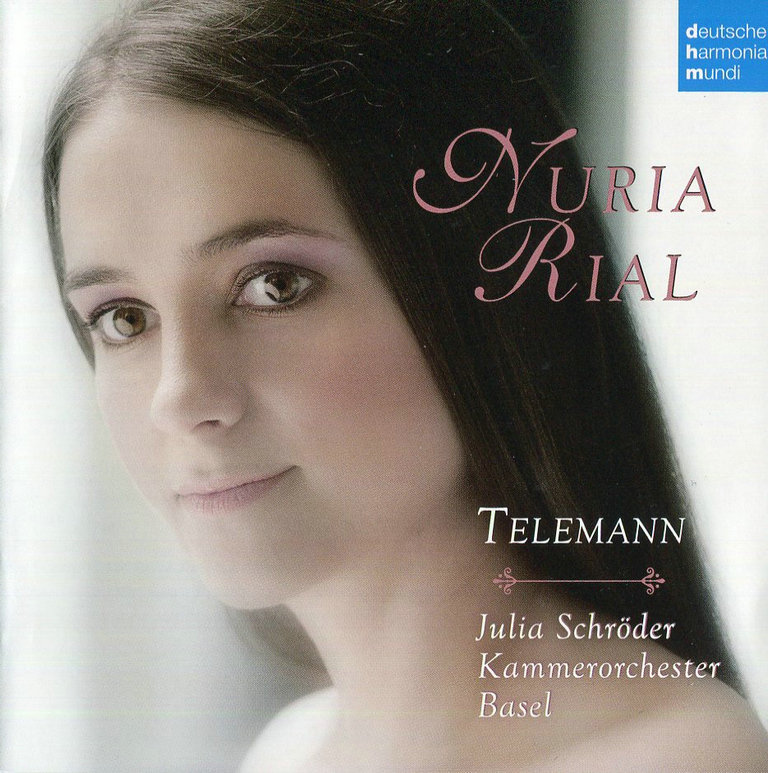
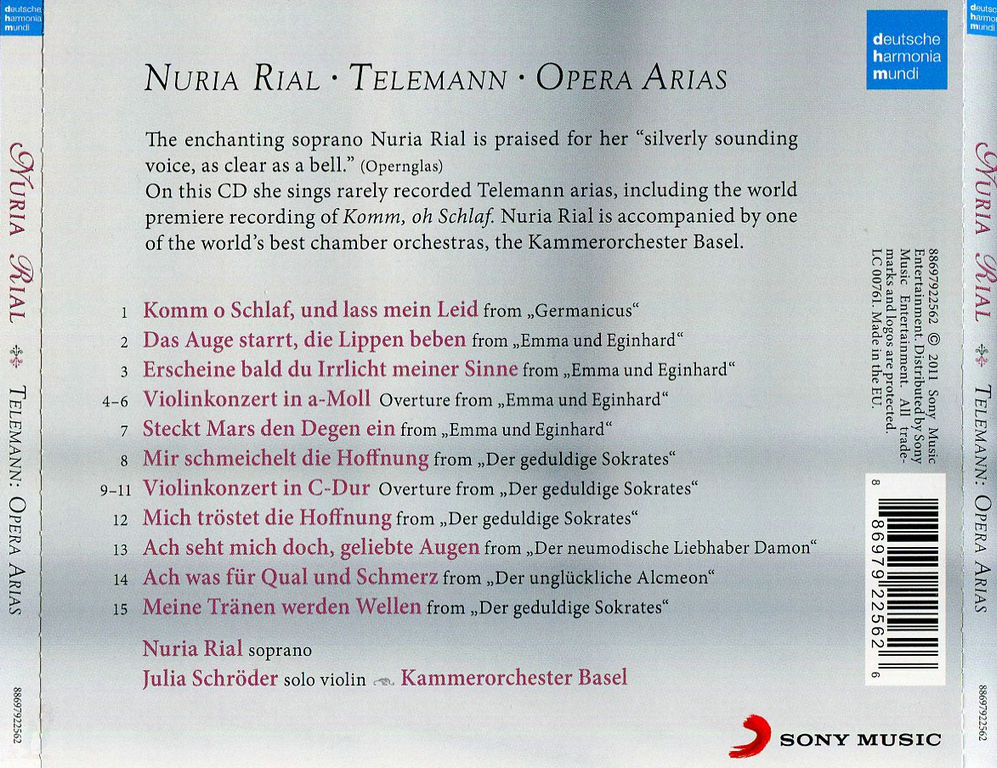
Telemann: Opera Arias


Nuria Rial is one of the leading baroque soloists and is famous for her shining, crystal clear and beautiful voice. In this album she sings, with the world famous Kammerorchester Basel, nine rarely recorded German arias by Georg Philip Telemann. They are taken from rarely performed operas by this underestimated baroque composer: "Emma and Eginhard", "Der geduldige Socrates" and "Germanicus". The aria "Komm, oh Schlaf" from the opera "Germanicus" is a world premier recording, the scores only being found a couple of years ago in Frankfurt. The disc also includes two violin concertos from which the Overtures to “Emma und Eginhard” and “Der geduldige Socrates” are taken.


“[In 'Come, o sleep, and let my cares'] the gentle, courtly tone so effortlessly sustained by Rial is elevated by the use of two flutes amid a glowing orchestral arrangement. The delightful feathery fluting of concertante recorder likewise helps animate the emotional quandary of "Hope gives me comfort"” --The Daily Telegraph

MP3 320 · 129 MB

Thứ Ba, 20 tháng 3, 2012

Telemann: Complete Violin Concertos Vol. 1


"In this, the first disc in a series covering the violin concertos of Telemann (of which there are twenty), we have cause for rejoicing. These performances are so fine, and this music so appealing and elegant, that I immediately listened to the entire disc through a second time…. rare praise indeed" --MusicWeb International


MP3 320 · 124 MB

Thứ Sáu, 16 tháng 3, 2012

Recorder Concertos


Michala Petri, since long firmly established as one of the leading soloist recorder players of today with a very successful international career and numerous recordings, has received the highest praise for her astonishing virtuosity and musicality in a repertoire ranging from the early baroque to contemporary works, many of them especially written for her.

This CD presents an enjoyable selection of recorder concertos by Vivaldi, Telemann, Marcello and Naudot.


MP3 320 · 101 MB

Thứ Tư, 14 tháng 3, 2012

Telemann: Flute Concertos


“You'll rarely hear such personality in a Baroqueconcerto soloist as the extraordinary Emmanuel Pahud exhibits here. Berlin Baroque Soloists acclimatise effortlessly to an 18th-century palette, and distinguished colleagues they make for Pahud. The flautist sets out his stall from the Andante of the succinct G major concerto (completed from a damaged source and therefore making its recording début) whose startling resemblance to the slow movement of Bach's F minor Concerto, BWV1056, seems to inspire Pahud to a lyricism of understated elegance which one often hears in the best performances of the Bach work.


Indeed, it's his sensitivity to Telemann's gestural implications and ability to colour the music at every turn which makes Pahud's playing so enchanting in all five concertos.

Telemann performance on a modern flute will inevitably lead to some recoiling, but one never feels deprived of the gentle and beguiling articulation of a 'period' instrument or its capacity for soft dynamic and purity of sound. One only has to hear the lithe performance of the A major Triple Concerto, from Part 1 of Telemann's famous banquet publication of 1733, Tafelmusik, where character abounds through Pahud's concern with first principles. Joyous exchange and textural delights abound in the Triple Concerto in E major, where Wolfram Christ's viola d'amore and Albrecht Mayer's oboe d'amore combine with the flautist in a ravishingly blended montage. The Flute Concerto in D confirms everything about Pahud's exquisite taste and mesmerising sound. A real winner.” --The Gramophone Classical Music Guide 2010

MP3 320 · 143 MB