Hiển thị các bài đăng có nhãn Bach Johann Sebastian. Hiển thị tất cả bài đăng

Thứ Hai, 16 tháng 9, 2013

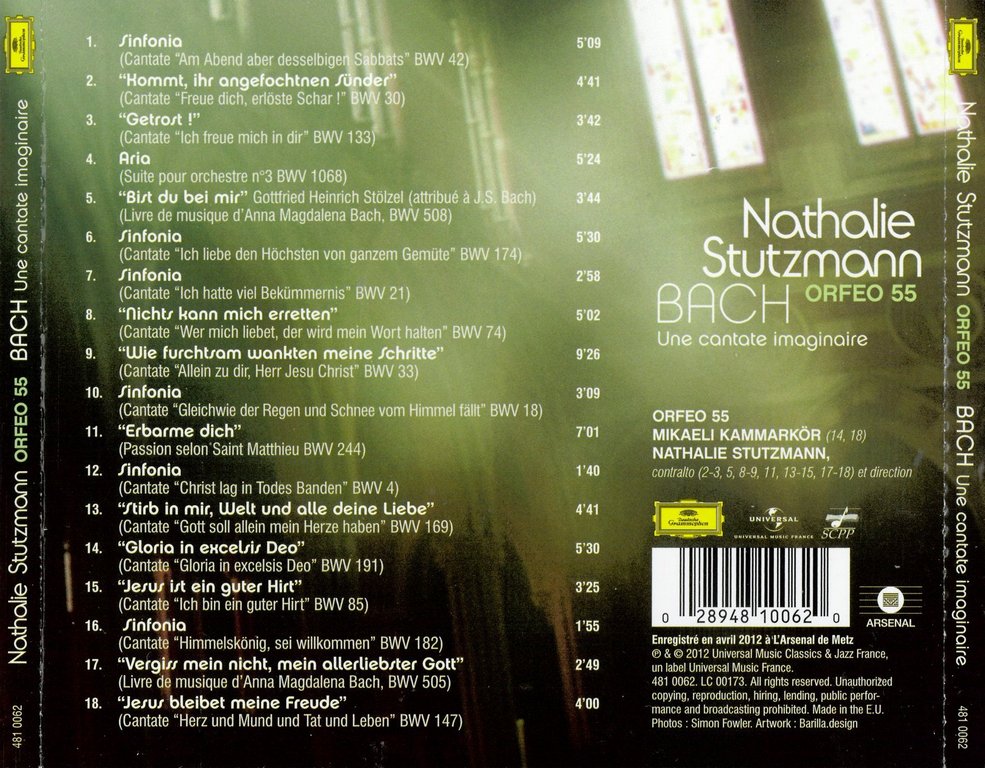
Bach: Une cantate imaginaire


“Her contralto is distinctive - at once voluptuous and androgynous, with an impressively wide range and sure technique - while her direction is idiosyncratic. At times, her approach seems mannered...Elsewhere, though, Stutzmann really captures the sublime quality of Bach's sacred music” --BBC Music Magazine, March 2013 ****

“This is certainly a very attractive and intelligent offering indeed, astutely compiled and most beautifully performed.” --International Record Review, February 2013


“Stutzmann has an ear for captivating attention and her orchestra, Orfeo 55, are often as responsive to her 'stick' as they are to her dark-hued vocalisation...Immediacy of sentiment and fresh anticipation of the core 'conceit' of each one of these disparate movements is Stutzmann's strongest suit...This [disc] is, overall, rather too much of a good thing - but still admire the sparkle and committed intent.” --Gramophone Magazine, February 2013

“Stutzmann has a unique voice, one which hasn’t always appealed to me. However, she uses it to good effect here. Her fruity, sometimes throaty contralto has a unique colour that sets it apart...Orfeo 55 make a lovely sound, lithe and flexible with great rhythmic bounce, and they’re shown off to their finest effect in the Sinfonia that opens the disc.” --MusicWeb International, January 2013

Chủ Nhật, 28 tháng 7, 2013

JS Bach: Concertos


“Mullova plays the two solo concertos elegantly, with beautiful precision and, in the middle movement, considerable eloquence.” --Gramophone Magazine, July 2013

“Mullova plays the glorious ‘Siciliano’ second movement beautifully, while tongue-in-cheek elaborations in the accompaniment lend a sense of uninhibited exuberance to the finale… The two orginal concertos match anything else on disc.” --BBC Music Magazine, August 2013 ****


“thrilling, robustly profiled accounts” --The Observer, 5th May 2013

“Breezy tempi, scintillating details and muscular bowing in the allegros cede to slow movements of thoughtfully differentiated timbres” --The Independent, 6th July 2013

“The Violin Concertos in E major and A minor are served wonderfully. Both performances are transparent and light but always expressively engaging… Dantone’s continuo in the first movement of the E major finds Mullova revealing a tremendous depth of feeling.” --International Record Review, July/August 2013

Thứ Bảy, 20 tháng 7, 2013

Bach: Goldberg Variations BWV 988 (Arranged for String Trio)


"...you shouldn't miss Rachlin, Imai, and Maisky's consistently compelling, tonally vibrant reading . . . Recommended!" --ClassicsToday.com, April 2007

"The faster variations come off best, particularly the canonic ones, where the separate contrapuntal lines are played with some vigour in the phrasing." --BBC Music Magazine, March 2007


The present version . . . results in one of the most appealing transcription performances to have come across my path in some time. The balance between the three instruments is ideal and the recording acoustic suitably chamberish . . . this rendition is in fact replete with unfailingly tasteful variations in dynamics and articulation that sustain interest . . . to the extent that I was genuinely sorry when the performance ended. --Fanfare. November 2007

Of all trios who've tackled this opus on disc, DG's all-star crew outclass the others insofar as technical proficiency . . . Not one smudged, swallowed nor rhythmically unfocused note infiltrates the rapid, clearly delineated passagework in Vars 5, 14, 2, 23 and 29. Conversely, the musicians' delicacy and pinpointed control in the minor-key variations never allows the harmonic tension to slacken . . . Maisky reveals a deft and thoughtful ensemble sensibility different from his larger-than-life solo persona. Nobuko Imai's rich, penetrating viola timbre proves an anchoring influence and her supple, perfectly in-tune high-register work particularly impresses in Var 17, where the violin sits out. Virtually all repeats are observed in this excellently engineered release. --Gramophone, April 2007

Chủ Nhật, 14 tháng 7, 2013

The Wigmore Hall Recital: Schubert, Brahms, Mendelssohn, J.S. Bach


Over four decades since securing worldwide recognition as one of the finest musicians of her generation, Maria João Pires continues to transfix audiences with the immaculate integrity, eloquence and vitality of her art. With Pires partnered by Antonio Meneses, cellist with the Beaux Arts Trio and artist of great wisdom and imagination, this recital is clearly a red-letter event for chamber music connoisseurs. "[Meneses's] warmly eloquent understatement matched Pires's own, and grave us something close to perfection" --The Telegraph, Jan 2012


"Portuguese pianist Maria João Pires shared her recital with cellist Antonio Meneses, in a performance which brought a real sense of community, of intimately shared music-making." --The Times

Thứ Sáu, 21 tháng 6, 2013

Bach: Partitas for Solo Violin Arranged for Guitar


“Korhonen's phrasing and articulation are intelligent and musical, and the execution is clean and crisp. Sometimes the downstroke of the bow is imitated...at other times...a more flowing, guitaristic approach is adopted.” --Gramophone Magazine, October 2010

“Korhonen always adheres closely to Bach's concepts, so that the notes added to the original violin score, filling out the harmony and adding basses, are subtle and never harmonically jarring...He plays with the intensity of one who really knows these works...one feels his love and admiration for these pieces.” --International Record Review, October 2010


This specially priced new recording features guitarist Timo Korhonen with the Partitas for Solo Violin by J.S. Bach, and his own arrangement for modern guitar.

This release follows on the success of the Bach Sonatas for Solo Violin (ODE1128-2). While many guitarists carry single movements in their repertoire, such as the famous Ciaccona from Partita No. 2, Timo Korhonen’s acclaimed project covers the complete Sonatas and Partitas for Solo Violin.

Korhonen’s transcriptions remain very faithful to the original violin score: “My aim was to execute the musical content, as if Bach had actually written it for six-string guitar back in 1720.” Timo Korhonen

Thứ Ba, 11 tháng 6, 2013

Bach: Cello Suites Nos. 1, 4 & 5 transcribed for viola


“Rysanov really claims the music for his lush-toned 1780 Guadagnini viola in a manner that few can rival...He gives a spring to the dance rhythms that sounds spontaneous, irresistibly so...No admirer of great viola playing should forgo the pleasures of Rysanov’s playing.” --Sunday Times, 22nd August 2010 ****

“Rysanov eschews both puritan authenticity and inappropriate Romantic emoting. His phrasing pays due acknowledgement to the suites' dance roots.” --BBC Music Magazine, October 2010 *****


The young violist Maxim Rysanov makes his debut on BIS with three of Bach’s suites transcribed for viola by Simon Rowland-Jones.

Recognised as one of the world’s finest and most charismatic viola players, Maxim Rysanov performs worldwide as a concerto soloist and chamber musician. Rysanov is a past recipient of both the Classic FM Gramophone Young Artist of the Year and the BBC New Generation awards and is a prizewinner of the Geneva International Music Competition and Lionel Tertis International Viola Competition among others. Originally from the Ukraine, he studied with Maria Sitkovskaya in Moscow and with John Glickman in London, his adopted home town.

Thứ Sáu, 31 tháng 5, 2013

Bach: Sonatas & Partitas BWV1004-6


“Faust's account of the music is gently voiced and eloquently inflected. Her lightly articulated bowing, which eschews anything in the nature of aggressive declamation, is a constant pleasure...a poetic player with an irresistably warm sound, a tightly controlled vibrato and an athletic technique.” --BBC Music Magazine, May 2010 ****

“Quite often her playing allows a generous measure of rhythmic freedom...at other times she's concerned to maintain a strong momentum....In short, Faust has a magnificent grasp of this music. Hear her if you can!” --Gramophone Magazine, June 2010


“Her serious dedication soars from her Stradivarius, a dark-toned beauty but capable of much silver light in its higher reaches...Faust’s wonderfully focused playing pulls you right inside the music, and magically makes you imagine the harmonies that Bach only implies.” --The Times, 10th April 2010 ****

“Faust finds her own distinct path, using minimal vibrato but deploying varieties of tonal colouring and proving plucky enough to add pliability to a phrase or to pause momentarily for expressive effect...[She] plays with exuberance, grace and, in the gavotte, minuets, bourrée and gigue, with polished élan.” --The Telegraph, 16th April 2010 ****

“Isabelle Faust has made a special impression as a deep, thoughtful, unshowy player, and these qualities make her ideally suited to the great Bach solo works...her command of the big structures, especially the huge C major Fugue and D minor Chaconne, is superb.” --The Observer, 27th June 2010

“[Faust's] sound is deliciously straight with little or no vibrato, and bowed with such sensitivity to Bach’s phrasing that you could almost kid yourself at times that she’s using a baroque bow. But a couple of features are especially telling: her instinct for ornamentation in the repeats, and the sense of cumulative musicianship” --Andrew McGregor, bbc.co.uk, 24th June 2010

“Her thoughtful approach is well suited to such searching music, and while there have been warmer, more spontaneous and expressively charismatic performances, few can match Faust’s intellectual concentration, purity and poise.” --Financial Times, 11th August 2012 ****

Thứ Tư, 29 tháng 5, 2013

Bach: Goldberg Variations, BWV988


“a pleasing blend of intellectual rigour, robust declamation and leisurely reflection.” --BBC Music Magazine, April 2010 *****

“Happily, Staier's effortless virtuosity (hear the trills in Variation 28!) and sensible musicianship go together to make this a strong Goldberg...The instrument is undoubtedly a major star here but that need not stop us from recognising its player as a master harpsichordist.” --Gramophone Magazine, June 2010


“Astounding — not so much because of Staier’s interpretative approach to Bach’s keyboard glory: it’s more the instrument he’s playing...The colour range is enormous. So is the sound’s breadth...There’s great musical theatre in every track, plus peerless beauty and intellectual heft.” --The Times, 13th February 2010 *****

“Staier sustains a courtly musical protocol in, for instance, the four-voice Fughetta of 'Variation 10', while elsewhere executing the complex hand-crossing of 'Variation 5' with a dexterity that presents the piece as part maze, part cascade.” --The Independent, 19th February 2010 ****

Chủ Nhật, 26 tháng 5, 2013

Bach: Sonatas for Solo Violin Arranged for Guitar


An interesting and well-conceived new reading of the masterpieces. --Steven Ritter, Audiophile Audition, May 18, 2009

Korhonen's style of playing has a beautiful economy and utmost clarity of line. (...) The end result we hear in these performances is a luminous beauty that often has decided spiritual dimension. --Atlanta Audio Society Journal, April 2009


This recording features Finnish guitarist Timo Korhonen with his own published transcriptions of famous violin works: Johann Sebastian Bach's three Sonatas for Solo Violin. Timo Korhonen's arrangements for modern guitar remain very faithful to the original compositions, and the historically informed performance reveals Korhonen's profound understanding of their style. In the booklet notes, Timo Korhonen reveals his theory about the meaning of the works.

Timo Korhonen is a real insiders' tip with a loyal fan base at major festivals and concert venues around the globe. His imaginative and innovative performances of contemporary and less known works continue to create much excitement. Concerto appearances feature him along with conductors such as Esa-Pekka Salonen, Jukka-Pekka Saraste and Sakari Oramo. His acclaimed recordings for Ondine include Leo Brouwer's 'Helsinki Concerto,' dedicated to him by the composer, which won a Cannes Classical Award in 2003 (ODE 979-2).

Passacaglia


“an exceptional set of works performed by a young organist with outstanding skill.” --MusicWeb, May 2013

The Passacaglia is a musical form based on a repeated bass line over which variations are composed. The form was popular during the 17th century but proved to be a challenge in its structural restrictions for composers of later periods, continuously renewing and extending the form, while keeping to its basic formula.


This original program brings together composers from 4 centuries: from Kerll, Couperin, Buxtehude and the monumental Passacaglia in C minor by J.S. Bach, far into the 20-th century with Reger, Shostakovich and Jan Welmers.

Recorded on the magnificent Martti Pothan organ Kotka Church in Finland, by young virtuoso Matthias Havinga, whose earlier recording on this organ (Brilliant Classics 94203) with Italian Concertos by J.S. Bach received enthusiastic reviews in the press.

New recording, including extensive liner notes and information on the instrument. Consisting of variations framed in a constantly repeated basso ostinato, the passacaglia is a musical form with a long and fruitful history. This release is dedicated to eight such examples which, taken from four countries and all performed on the organ, divide either side of the year 1800 to reveal the form’s extensive and inventive development over time. The passacaglia was particularly popular during the 17th century, when it became known for its limited range of keys, slow triple meter and short, simple theme of two or four.

Thứ Sáu, 24 tháng 5, 2013

Rachmaninov, Bach/Busoni, Ravel & Stravinsky: Piano Works


“In Rachmaninov's Corelli Variations, Kempf distinguishes himself for assiduous, well-integrated tempo relationships between movements, and the easy command and intelligent, symphonically orientated delineation with which he shapes the composer's thick textures...Kempf's glittering technique, supple touch and extroverted demeanour in Stravinsky's Three Movements from Petrushka bring out the music's balletic roots” Gramophone Magazine, July 2011


“this is a colourful and enjoyable account [of Petrushka], well-characterised and full of dynamic contrast...fans of Kempf need have no qualms about acquiring this release.” --BBC Music Magazine, June 2011 ****

“Kempf opens with a beautifully-voiced and judiciously-paced view of Rachmaninov's Variations...he finds a meltingly silvery touch for the Ravel Valses (exquisite) before a return to the Russian repertoire that he plays so well, leaving us, thrillingly, in no doubt that the piano is a percussive instrument.” --Classic FM Magazine, July 2011 ****

“Kempf follows [Bach's] text faithfully, allowing each variation to shape the movement without sounding forced...[He] shows an impressive range of organ-like colour along with a pointillism that suits quick passages well...The scene of 'Shrove-Tide Fair' is a roller-coaster ride under Kempff's fingers, driven by a motoric energy that many pianists would find difficult to sustain over eight-and-a-half minutes.” --International Record Review, April 2011

Thứ Sáu, 10 tháng 5, 2013

Bach: Sonatas & Partitas BWV1001-3


“In some of the most challenging violin music ever written, she displays masterly technique...Despite some daring tempos, Faust retains a totally secure pulse through all the technical contortions. She places admirable faith in Bach's fair copy of the score...[and] in alluringly sensitive in gentler movement.” --BBC Music Magazine, November 2012 *****

“Unbeatable playing in the conclusion to a benchmark Bach project” --The Strad, November/December 2012


“She creates a feeling that, although there is a deep musiucal understanding behind her performance in which she has quiet confidence, there is no overarching ego trying to make the intricate counterpoint bend to her will.” --Gramophone Magazine, November 2012

“Faust’s playing of these extraordinary pieces of surpassing musical interest and lyrical content sits comfortably at the uppermost echelons of the league table … Faust is at her heart a poetic player with a warm sound, a tightly controlled vibrato and an athletic technique … A rewardingly stimulating release, beautifully recorded.” --International Record Review, November 2012


Thứ Ba, 7 tháng 5, 2013

J.S. Bach: Lute Suites Nos. 1-3

One of today’s 'popes' of early and baroque lute playing, Hopkinson Smith returns to the magic masterpieces of Bach and records the renowned Suites BWV 1007, 1008 and 1009, transcribed by himself for the German theorbo...

Bach was a musical ecologist, the masterful recycler of his own compositions, arranging more than a few from one instrument or combination of instruments to another. Many of his works seem conceived on a somewhat abstract plane, above and beyond any specific instrument, and it was completely natural for the pragmatic 18th-century mind and ear to adapt them to the instrument of its choice.


Among the so-called ‘official’ lute works of Bach, there exist two such adaptations: from the solo violin repertoire, the Third Partita, BWV 1006, becomes BWV 1006a for the lute, and the Fifth Cello Suite is transformed into the Lute Suite in G minor, BWV 995. Of course, lutenists had been adapting music for their instrument for centuries. More than half of the continental lute music of the Renaissance is made up of adaptations of vocal works. In the French baroque, Robert de Visée couldn’t stop making transcriptions for his theorbo of orchestral and keyboard works by his contemporaries. The great 18th-century German lutenist, Sylvius Weiss, a friend of Bach’s, was said to have played violin concertos directly on the lute.

These examples of adaptations are not given as a kind of ‘justification’ for the present project as if the idea needed to be defended historically. It is more to guide the modern musical thinker (who sometimes knows more about ‘authenticity’ than did the musicians of former times) to the state of experimentation and discovery that is completely natural for the musician: one sits alone with one’s instrument without a score, playing melodies and harmonies that one has heard here or there and making them one’s own.

Thứ Tư, 24 tháng 4, 2013

Bach: Violin Concertos


Simon Standage is well-known as a violinist specialising in seventeenth and eighteenth century music. Leader and soloist with The English Concert from its foundation until 1990, he also fulfilled the same role for many years with the City of London Sinfonia. As well as the many records he made with The English Concert (including Vivaldi's The Four Seasons, nominated for a Grammy award), he also recorded solo and chamber music - including all of Mozart's violin concertos - with the Academy of Ancient Music, of which he was, with Christopher Hogwood, Associate Director from 1991 to 1995.


Thứ Bảy, 20 tháng 4, 2013

The Father, the Son and the Godfather


“Paradiso Musicale is an ensemble of compelling soloists, each with virtuosity and insight to burn, but it's nonetheless an ensemble in the ultimate sense, sparking fruitful conversations yet speaking as one responsive voice...this is a hugely impressive debut disc.” BBC Music Magazine, February 2012 *****

“This is something of a breath of fresh air across the landscape of today's baroque recording. The two upper voices of Paradiso Musicale are Dan Laurin's recorder and Henrik Frendin's viola, which thoroughly unconventional pairing gives them a fresh take on textural matters...this is a very enjoyable disc.” --Classical Music, February 2012 ****


The Father, the Son and the Godfather is a snapshot of a time when composers were offered a tremendous freedom in their choices of genres and styles and features three composers who knew each other well: J.S. Bach (the father), C.P.E. Bach (the son) and Georg Philipp Telemann (CPE’s godfather).

We thus get Johann Sebastian’s rigorous, intellectually demanding Sonata in B minor, ample examples of the elegant and tender Empfindsamer Stil of his son C.P.E., and in two Trio Sonatas a taste of Telemann’s ‘world music’

This is the first recording of Paradiso Musicale, an ensemble featuring the acclaimed recorder player Dan Laurin and made up of an unusual combination of instruments.

Bach: English & French Suites · persuccion transcriptions


Danish natives Uffe Savery and Morten Friis met in 1977 while participating in the Tivoli Garden Boys' Guard and later attended the Royal Danish Conservatory of Music. The two created an experimental project called Safri Duo. Discovered by a label executive working for a classical department, they teamed up with a trance producer and signed with Universal Denmark in 1999 to make a dance/club record that combined traditional ethnic and last generation instruments. Safri Duo won a Danish Music Award for Best Danish Club Hit with "Played-A-Live (The Bongo Song)," released worldwide in January 2001.


Thứ Năm, 18 tháng 4, 2013

Bach: Sinfonia


“Although it might seem a strange idea to make a CD of the orchestral introductions to Bach’s cantatas, there is sufficient variety of mood – from celebratory to contemplative – to make the programme work as a sequence...the where-have-I-heard-that-before element is part of the disc’s attraction, and the superb Accademia Bizantina makes the music live and breathe.” --The Telegraph, October 2011 ****


“this is a wonderful recital, carefully chosen and assembled, and beautifully played...there are movements highlighting the group’s fine oboists, bassoonists, violinists, trumpeters and, slightly less impressively, horn players. Their style is brisk and energised in the faster music and deeply expressive and spacious in the slower.” --Sunday Times, November 2011


Thứ Tư, 27 tháng 3, 2013

Bach: St Matthew Passion, BWV244 · Final performing version, c. 1742

“The thread of intensity is achieved largely by the focus and roundness of the Dunedin Consort's palette, the thrusting legatos (when called for) and the welcome presence of a strong, directed bass-line. No recorded St Matthew Passion…comes without its blemishes but few parade such a compellingly fresh and raw realism.” --Gramophone Magazine, April 2008

“From the word go, the Dunedin Consort draws you in. The instruments are perfectly balanced, the playing is soulful, there are subtle swells, and the lilting tempo strikes a happy medium between pace and sobriety.” --Charlotte Gardner, bbc.co.uk, March 2008


“One-to-a-part Bach infiltrated the St Matthew Passion with Paul McCreesh in 2002. I described him then as 'provocative and compelling', and John Butt is no less so. Of his eight remarkable singers (plus two unison sopranos for the opening chorus' crowning chorale) several are barely out of college, but they match spine-tingling tone with astonishing maturity.” --BBC Music Magazine, April 2008 *****

“Having swept the board with their Awardwinning Messiah, John Butt and the Dunedin Consort and Players proceed headlong into the summa of dramatic religious masterpieces. One imagines, however, that this highly singular approach has been marinating in Butt's mind for years. This is a reading (the first to draw on the 1742 performing version with its re-allocation of continuo instruments) where scholarly and musical penetration is indivisible in the strength of the approach and the unswerving commitment of the 'players'.

And 'players' they are – except that Butt argues here for a new dramatic understanding of the Matthew (note the curious de-sanctification) where the work challenges the notion of 'parts' in an opera, towards various 'voices' which reflect the listener's absorption of the conflicting positions – both biographical and emotional – of the main protagonists and the most far-flung thresholds of human experience.

This is achieved using the main singers, from the eight principal voices, in different contexts. Hence, as Butt explains in his illuminating note, the Evangelist may rally us to lament as an allegorical 'Daughter of Zion' in the opening chorus before darting in and out of the story in recitatives, chorus, aria and chorales, mixing up the past and present, first person and third person, in a web of intense and coherent narrative and reflection.
All of this presupposes a one-to-a-part troupe where all these subtle character combinations can be perceived. With such a spectacularly clear and balanced sound from Philip Hobbs, these ambitious perspectives are powerfully realised; refreshingly, too, Bach's 'novel in sound' is presented in a small inter-reliant ensemble without the need for tiresome dog- matic mantras on historical rectitude. Indeed, often so entwined are the textures that singers' vowels are shadowed by instruments in a closeknit rapport of exceptional immediacy.

For those steeped in both recent and old schools, this performance will resonate with both, though it is not always so easy to summarise how. The thread of intensity is achieved largely by the focus and roundness of the Dunedin Consort's palette, the thrusting legatos (when called for) and the welcome presence of a strong, directed bass-line.
Such responses are relatively superficial because Butt's St Matthew is truly original in spheres resonating beyond established parameters.

As his story-teller, Nicholas Mulroy brings his own striking naturalness of delivery, clarity of diction and honesty. At the start of Part 2, especially, there are moments of disarming reportage, such as the encounter with the High Priest where the Evangelist conveys a sickened response to Christ's humiliation and a gutting catch in his voice at the emptiness of Peter's denial. Yet it is Mulroy's identification with the outstanding Christus of Matthew Brook which raises the stakes in this performance. The timing between the two and the realism of the musical choreography is both remarkably patient and animated.

The only downside of a single-part St Matthew is that, while the singers – in Butt's words – 'become familiar to us as the piece progresses', this only works to advantage if they have the tonal and musical range to sustain such an extended and exposed vision. For all the stylistic nuancing and deft ensemble work of the sopranos, their arias rarely lift themselves beyond the generic. 'Ich will dir' sounds unsure and snatched and 'So ist mein Jesus gefangen' fails to demarcate the almost cosmic mystery ('moon and light have set in their anguish') alongside the admirable discipline of the crowd's graphic interjections.

No recorded St Matthew Passion comes without its blemishes but few parade such a compellingly fresh and raw realism, one so strongly identifiable by its wilful clarity of intent that it asks new questions about what this great work can say to us.” --Gramophone Classical Music Guide, 2010

Chủ Nhật, 10 tháng 3, 2013

The Art of Instrumentation: Homage to Glenn Gould


“Typical of Gidon Kremer's concept albums, it imaginatively showcases a number of contemporary composers” --BBC Music Magazine, December 2012 *****

“Kremer is ideally placed to bring together the old and new, having championed Bach and been a tireless promoter of the music of living composer. Yet many of the transcriptions featured here are so faithful that one wonders whether the composers were afraid to tinker too much with the original.” --Gramophone Magazine, November 2012


“It could all seem supremely tacky and self-indulgent, and some of the tracks certainly are, but the best of the arrangements are extremely skilful and seriously musical, and Kremer and his superb young orchestra give them the respectful attention they deserve.” --The Guardian, 4th October 2012 ****

Thứ Hai, 5 tháng 11, 2012

Bach: Trio Sonatas


Rarely do we feel the presence of Bach so vividly on a recording as we do here with this set of Trio Sonata arrangements, performed by violins, viola da gamba, and harpsichord. What a perfect combination, thanks to Richard Boothby's settings and to the wonderfully synergistic interaction among these very experienced early music players--violinists Catherine Mackintosh (in her best recorded performance in a while) and Catherine Weiss, gambist Boothby, and harpsichordist Robert Woolley. 


There's certainly nothing wrong with arranging Bach's music like this--and indeed, Boothby does "mix things up" by transposing keys and instrumental lines--as Bach himself reused, rearranged, and transposed his own and others' music. 
 
In these string versions of pieces normally performed on the organ we hear occasional enticing hints of the violin concertos and, because of the instruments' different registers and colors, the lines emerge in new and surprising ways. This disc makes a nice companion to Bernard Labadie's arrangement of the Goldberg Variations for strings and continuo, recorded with Les Violons du Roy on Dorian (see reviews and features): both are distinguished for their learned, totally faithful, yet refreshingly entertaining and enlightening recastings of music that's not only timeless but seemingly limitless in its revelatory capacity. 

The sound is demonstration quality--this is one of those recordings that when you turn it up to just the right level, the instruments come to stunningly real, three-dimensional life, no fancy surround-sound or other high end equipment needed. --David Vernier, ClassicsToday.com