Hiển thị các bài đăng có nhãn 20th century. Hiển thị tất cả bài đăng

Thứ Bảy, 21 tháng 9, 2013

Khachaturian: Symphony No.2, Gayaneh Suite


Aram Khachaturian was one of the most popular composers of the Soviet period of Russian history, successfully managing to combine the folk music of his native Armenia with the more formal Russian musical tradition as represented by Rimsky-Korsakov. Born in 1903, he showed early signs of a love of music, but his formal training did not begin until 1922, when he was admitted to the famous Gnessin Institute in Moscow (his family having moved there the previous year) and continued at the Moscow Conservatory with the eminent composer Myaskovsky.


The first major work of Khachaturian to be performed was his Symphony No. 1 (1934). International acclaim greeted his rumbustious Piano Concerto of 1936, the success of which was quickly duplicated with the Violin Concerto of 1940, and throughout the 1940s Khachaturian composed many successful works, such as the ballet Gayaneh with its famous Sabre Dance (1942), his Symphony No. 2 (1943) and Cello Concerto (1946).

His Symphony 2 is perhaps darker--in both mood and orchestral color--than his other symphonies; but then it was written in 1943 in the midst of World War II and Stalin's ongoing purges of the Soviet bureaucracy. However, works such as Gayneh almost guaranteed that Khachaturian would stay out of jail.

Thứ Tư, 18 tháng 9, 2013

Casella: Concerto for Orchestra, Pagine di guerra & Suite


"Solo work is polished and distinctive, and the ensemble is well blended and disciplined. Conductor Francesco La Vecchia seems to know what he wants to get out of these scores…If you have enjoyed earlier releases in this series, there is no reason to hesitate. If you haven’t heard Casella yet, then what are you waiting for? This disc is as good a place as any to begin." --Fanfare, May 2013

"Playing, interpretation, and sound are all good. This pioneering Naxos survey of the Italian symphonic tradition has opened my ears to a worthwhile composer." --American Record Guide, January 2013


"These performances are extremely fine. Chandos just released the Concerto in its own Casella series…but I prefer Francesco La Vecchia’s more relaxed way with the music. If his orchestra isn’t perhaps as polished as the BBC Philharmonic, his approach gives the piece just that much more breathing room to make an impression. He allows its Italianate lyricism to blossom naturally, while the neoclassical chatter of its rhythms never turns mechanical. The engineering also ranks with the best in this generally excellent ongoing series. Both the Suite and Pagine di guerra are recording premieres. This disc is a treat, and a major release." ---ClassicsToday.com, October 2012

"…here is a tribute to La Vecchia’s judicious balancing of raw pictorialism and real feeling.

The Concerto for Orchestra, dedicated to the Dutch conductor Willem Mengelberg, is the most substantial work here. It’s also a summation of Casella’s progress to date; in the highly animated Sinfonia various parts of the orchestra are allowed to shine, those see-sawing string figures reminiscent of Shostakovich at times. That said, there’s a boldness—an ease of invention if you like—to Casella’s writing that confirms he’s mastered his craft; the Passacaglia, artfully worked, is not as dry as one might expect, and the finale takes us on a thrilling ride…La Vecchia and his band are every bit as engaged—and engaging—in this strange, delightfully dishevelled work.

Music of unbridled energy, a big, sense-sating sound and unusually detailed liner-notes add up to a most desirable package. In short, Naxos have given us another cracker—and it’s not even Christmas!

Great fun; buy now and beat the rush." --MusicWeb International, October 2012

Thứ Bảy, 14 tháng 9, 2013

Schwertsik: Baumgesänge


“Gruber directs with conviction music he doubtless understands intuitively, while the BBC PO takes its many subtleties in its stride. Spaciously immediate sound, informative notes and a disc worth acquiring.” --Gramophone Magazine, November 2011

“Schwertsik's Viennese blend of gentle irony, nostalgia and absurdism has made little headway in the UK. This beautifully played orchestra disc should help.” --BBC Music Magazine, December 2011 ****


“Gruber ensures the best possible performances of music that proves very engaging... When listening there is an invitation to return to these appealing scores, and it’s difficult to think of them being better served than in these performance conducted by Gruber and captured in dynamic and vivid sound.” --International Record Review – September 2011

“Gruber is the BBC Phil’s composer/conductor, and Schwertsik (b1935) his lifelong Viennese friend and mentor, whose work he has tirelessly promulgated. These pieces well convey Schwertsik’s mercurial, ironic sensibility and his dextrous juggling of Romantic tonality and modernist impulse.” --Sunday Times, 4th September 2011

“The effectiveness of [Schwertsik 's] reconstituted language is shown in the three orchestral works by his close friend that Gruber conducts here. Nachtmusiken is the most recent: first performed by the BBC Philharmonic last year, it's a sequence of Viennese nocturnes, elegies and reminiscences of composers including Janácek, Mahler and Shostakovich.” --The Guardian, 25th August 2011 ****

“This disc of music by the quirky Austrian Kurt Schwertsik is a consistent joy...Schwertsik is far more than a skilled pastiche artist – ghosts from several centuries of Western art music drift in and out of these scores without overwhelming a distinctive and drily witty personality...Fantastic stuff, and sumptuously recorded.” --The Arts Desk, 15th October 2011

Gerhard: Symphony No. 2; Concerto for Orchestra


“Although the avowed purpose of Gerhard's Concerto for Orchestra (1965) was to highlight the orchestra as an entity rather than its constituent sections or instruments, and while it may not have the immediate universal appeal of, say, Kodály's or Bartók's works with the same title, it has never been surpassed for its imaginative handling of instrumental sonorities or for its virtuoso demands on the players. It has to be said right away that this is a stunning performance: not merely does the BBC SO rise spectacularly to the work's demands, but Bamert shows himself exceptionally skilful at securing internal balances.


It's worth quoting Gerhard's own words: 'My favourite listener is one who does not read explanatory programme notes … I stand by the sound of my music, and it is the sound that must make the sense…a work of music takes shape only in the mind of the listener.'

Gerhard's Second Symphony has been represented on disc only by the revised version (Metamorphosis) which had had to be completed by Alan Boustead (available on Auvidis Montaigne); although Gerhard may have felt the original too cerebral, it was at least all his, and tough going as it undoubtedly is, it's very welcome to all interested in the mental processes of this quite exceptional musician. The opening of the work's second section, with its clicking percussion, is hauntingly mysterious, and the final nightmare palindrome Scherzo (of which only a fraction exists in the Boustead version) is one of his most astonishing creations. With first-class recording throughout, this must be regarded as an essential disc for all admirers of Gerhard.” --Gramophone Classical Music Guide, 2010

Thứ Sáu, 13 tháng 9, 2013

Shostakovich: Symphony No. 5


“Eschenbach's live recording of Shostakovich Five with the Philadelphia is a monumental reading, seeking drama in the work's gaunt architecture rather than its moment-to-moment events.” --BBC Music Magazine, May 2008 ****

“formidable Ondine/Eschenbach/Philadelphia partnership” --Gramophone Magazine


One Five that won... - This release in the successful recording series with The Philadelphia Orchestra and its Music Director Christoph Eschenbach features Dmitri Shostakovich's epic and monumental Fifth Symphony, which has become a signature piece of the orchestra. The Largo movement - one of the most heartrendingly beautiful slow movements written by the composer - and the bombastic Finale of this perennially popular work provide for an entrancing super audio listening experience with the world-renowned sound of The Philadelphia Orchestra. Officially viewed as "the practical creative reply of a Soviet artist to just criticism," this symphony was the Russian composer's mid-career coup - after his music had been politically attacked, he got back into the good graces of both communist officials and the public, who stood and cheered its première in 1937.

An added bonus of this CD is the spellbinding song cycle 'Seven Romances on Poems of Alexander Blok' (1880-1921), making this unusual coupling a unique release; Christoph Eschenbach accompanies on piano the acclaimed mezzo-soprano Yvonne Naef and two members of the The Philadelphia Orchestra.

The Philadelphia Orchestra deservedly takes pride in its long and triumphant association with the music of Shostakovich, beginning with the U.S. premiere of his First Symphony in 1928, conducted by Leopold Stokowski. In fact, through 1973 the Orchestra gave the U.S. and Western premieres of seven of the composer's symphonies variously, as well as the First Cello Concerto, the First Piano Concerto, and the Five Pieces for Small Orchestra. Since Leopold Stokowski led the first Philadelphia performances of the Fifth Symphony in March 1939, the Orchestra has performed the work many times, as well as featured it on domestic and international tours, including performances in Russia under Eugene Ormandy in 1958.

Chủ Nhật, 8 tháng 9, 2013

Hallgrímsson: Cello Concertos


Truls Mørk projects the close-knit solo writing (in Herma) with his customary finesse, and he is no less insightful in the Cello Concerto (2003) dedicated to him. (...) the Scottish Chamber Orchestra, who respond with alacrity to the assured direction of John Storgårds. Excellent sound and decent notes help make this disc worth investigating by those who have enjoyed Hallgrímsson's understated individuality. --Gramophone, August 2009


The Cello Concerto is a major addition to the modern repertoire. (...) Truls Mørk plays both pieces with rich tone, total confidence, and a sure sense of the music's expressive trajectory. (...) Ondine's sonics are excellent. Definitely worth getting to know. --David Hurwitz, ClassicsToday.com, May 2011, Artistic Quality 9 / Sound Quality 9

This is (...) music of a very high order, wonderfully performed and recorded, and I recommend it to you with every enthusiasm. --International Record Review, May 2009

Thứ Sáu, 6 tháng 9, 2013

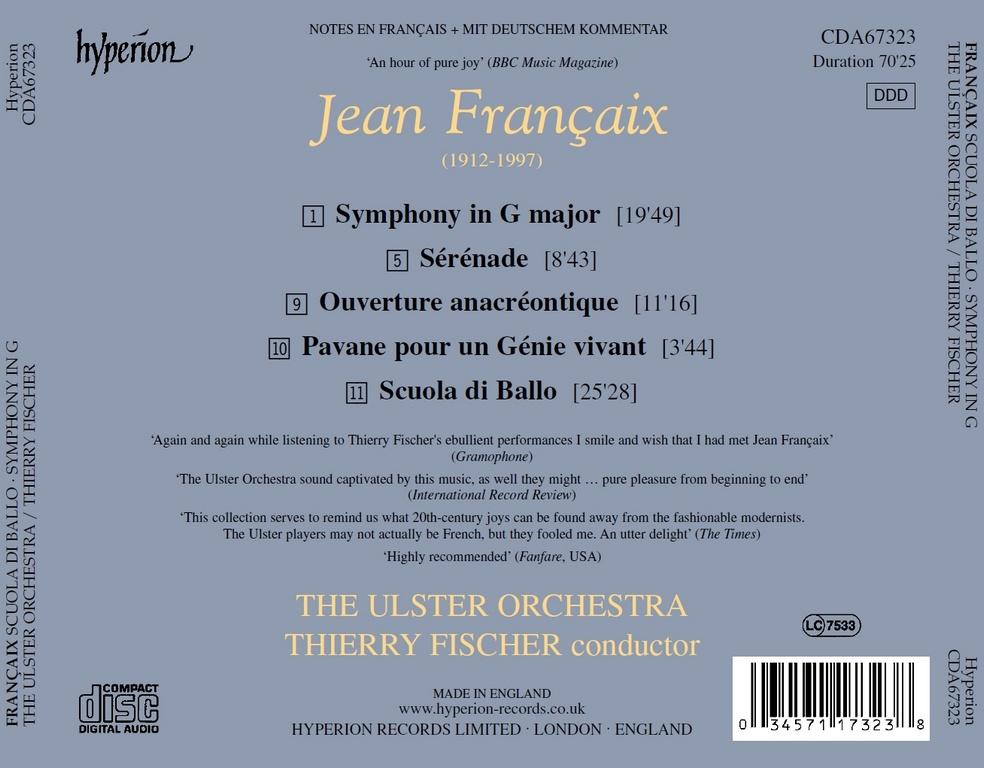
Jean Françaix: Orchestral Music


“An hour of pure joy...This album covers 50 years of Jean Françaix's droll, deadpan and meltingly lyrical work.” --BBC Music Magazine, December 2008

“What happy work [the Symphony] is!...The whole programme is played with warmth, polish and vitality in equal measure; the recording is first class and this is very highly recommended.” --Penguin Guide, 2011 edition


'Again and again while listening to Thierry Fischer's ebullient performances I smile and wish that I had met Jean Françaix' (Gramophone)

'The Ulster Orchestra sound captivated by this music, as well they might … pure pleasure from beginning to end' (International Record Review)

'This collection serves to remind us what 20th-century joys can be found away from the fashionable modernists. The Ulster players may not actually be French, but they fooled me. An utter delight' (The Times)

'The Ulster Orchestra has acquired a deserved reputation for the strength of its sectional work and the quality of its soloists, both aspects of performance that come to the fore in Françaix … Highly recommended' (Fanfare, USA) 'thoroughly entertaining and immensely intelligent' ( The Evening Standard)

'Très bien composé, ce nouveau disque témoigne parfaitement des influences et des particularismes de l’art clair et spirituel de Françaix' (Répertoire, France)

'Thierry Fischer secures some authentically Gallic character from the Ulster Orchestra … Wonderful' (Yorkshire Post)

Garofalo: Violin Concerto & Romantic Symphony


Born in the same decade as his more famous contemporaries, Malipiero, Casella and Pizzetti, Carlo Giorgio Garofalo composed a considerable body of sacred and secular music.

Until its 1994 Moscow revival conducted by Joel Spiegelman, Garofalo’s Romantic Symphony, admired by Toscanini and Nikisch, had been performed in full score only once. It is a dramatically gripping and uplifting work of unabashed Romanticism. Garofalo’s gift for sweeping melodies and well-rounded musical form is also evident in his Violin Concerto whose solo part gives ample opportunity for rapturously virtuosic display and poignant lyricism.


“Garofalo has a melodic gift and with a bit more experience might have given Respighi a run for his money.” --American Record Guide

"Two works are offered here—neither have opus numbers or dates of composition although the symphony did receive its first—and only complete performance prior to this Russian revival—in 1915. The disc opens with the Violin Concerto. The soloist here is Sergei Stadler. He won the 1982 Tchaikovsky competition at the age of 20 and his pedigree is not in doubt. Throughout he plays with great attack and fervour and succeeds in surmounting the many technical hurdles Garofalo puts in his way...there are several passages of rather beautiful [orchestral] playing—particularly from the solo horn and oboe." --MusicWeb International, September 2010

Thứ Hai, 2 tháng 9, 2013

Bloch: Schelomo & Voice in the Wilderness; Bruch: Kol Nidrei


“Clein's performance [of Schelomo] concentrates, most affectingly, on the atmosphere of deep introspection...thoughtful, subtle and satisfying, well supported by the passionate and spirited BBC Scottish SO...The Bruch, too, receives a lovely performance, with Clein bringing out the different colour of each of the cello's strings and the orchestra effecting most beautifully the transition from sombre to heavenly.” --Gramophone Magazine, September 2012

Gramophone Magazine Editor's Choice - September 2012


“[Clein's] impassioned, sensitive playing finds willing collaborators in the BBC Scottish Symphony Orchestra and their former principal conductor.” --Sunday Times, 15th July 2012

“Clein is the cello protagonist in all four works, her range of tonal colour, her animation and her discreet soulfulness proving to be ideal qualities...Kol Nidrei is one of the most beautiful works in the entire cello canon, a factor that this performance conveys in a blend of tranquillity and heartfelt ardour.” --The Telegraph, 27th July 2012 *****

“She and Volkov give a performance of Schelomo (1916) that is very moving, both in its profound sensuality and in the pervasive sense of transience that gnaws at its vision of worldly glory...Beautifully done, [Kol Nidrei] brings the disc to a reflective close. Highly recommended.” --The Guardian, 9th August 2012 *****

“As one might expect, Clein delivers a powerfully committed performance, but also manages to avoid over-indulgence, negotiating the peaks and troughs of the music's volatile emotional language with a clear sense of direction...Volkov brings a welcome transparency to Bloch's languorous instrumentation in the reflective sections.” --BBC Music Magazine, September 2012 ****

“one of the pleasures of the recital is the meeting of minds between orchestra and soloist, each perfectly partnering the other...It's a lovely piece of programming, tenderly performed.” --bbc.co.uk, 22nd August 2012

Thứ Bảy, 17 tháng 8, 2013

Paul Kletzki: Piano Concerto, Etc


"Joseph Banowetz is masterly in all these works, none of which could be described as easy to play. More than merely negotiating the challenges, he proves to be a genuine interpreter. Sanderling and the Russian orchestra provide good support (in what is definitely a supporting role), and the sound is excellent." --Fanfare, January 2011

Treated ‘like a son’ by Wilhelm Furtwängler and admired by Toscanini as both composer and conductor, Paul Kletzki was active as a composer between 1921 and 1942, relinquishing this creative outlet to become famous solely as a conductor.


All the works on this disc are adventurous, sometimes improvisatory, tonal pieces which push the pianist’s technique and musicianship to the limit.

The Fantasie is a colossal work of highly contrapuntal music, a sonata comprising four movements joined together within a single continuous movement, while the Piano Concerto may be counted among the most significant twentieth-century contributions to the genre.

Joseph Banowetz has been described by Fanfare as “a giant among keyboard artists of our time.”

Thứ Năm, 15 tháng 8, 2013

Frank Martin: Concerto For 7 Winds, Etc


The Concerto for seven wind instruments, percussion and strings [21.29] was premiered in 1949 and in its pawky humour owes somewhat to Stravinsky. The soloists imbue it with its full meed of character. I single out Celia Chambers for her delightful way with the flute part bringing out its relation with the Nielsen Flute Concerto. Philip Tarlton's bassoon serenading is chortled with great style. Ravel's Valse flickers alight at 5.23 in the Allegro but the second movement (typically of calmer character), in fact, is quite troubled among the undoubted elegance. A sour darker note recalls Kurt Weill's wind writing. 


The Allegro Vivace is lively and the trumpet's roulades even suggest a Genevan Arnold but there is yielding emotion as well as an anxious glance cast over the shoulder. Nightmares from the last war were still alive. The work was premiered in 1949.

The Studies for String Orchestra (1956) [20.47] was given its first performance by the insatiable Paul Sacher many of whose commissioned works have formed mainstays of the repertoire. This work is clean of line, troubled, varied and severe. There is a flighty tranquillo, a grandly satisfying pizzicato (brilliantly recorded by Chandos) seeming to picture an orchestra of wavering balalaikas in Spanish dress. The Allegro giusto is limber but does not give way to any overt romance.

Erasmi Monumentum (1969) is scored for organ and orchestra. The title reference is to Erasmus. The Homo pro se movement takes its title from the name by which Erasmus was known by his contemporaries. Dignified and slowly swelling its clean yet unglamorous counterpoint builds steadily. The organ comments discreetly and ending all in an ocean of calm. The Stulticiae Laus is almost knockabout - cackling and goading along the way. Querela Pacis (plea for peace) does not shrink from protest but its resolves into tranquillity. This was written, presumably, as a response to Vietnam.

The recording quality is in the reliably pellucid Chandos house style for the 1990s. This is an indispensable series neatly flanked by Richard Langham Smith's notes.

These works are not similarly coupled on any other disc.

Rob Barnett, musicweb-international.com

Thứ Sáu, 9 tháng 8, 2013

Janácek: Orchestral Suites from the Operas Volume 2


…the Naxos sound…is satisfyingly deep and wide…Breiner…does capture some of the opera’s distinctive rhythms and colours—just listen to those dashes of Taras Bulba starting at 1:52. Also, there is some lovely, tender playing at the start of the second movement, while in the third—where Kát’a looks forward to her clandestine meeting with Boris—Breiner conjures up vivid, authentic-sounding harmonies; there is more dramatic thrust here as well, although perhaps the sharper edges of Janáček’s score are somewhat blunted.


I particularly liked the free-flowing music of Intermezzos and Songs (tr. 4), where Breiner teases delectable sounds from his orchestra…the New Zealand Symphony…with flair and character throughout. The lovers’ brief moments of happiness are glowingly done, but before long we are plunged into the final movement and the approaching storm. This pivotal event is a lightning rod for all the opera’s pent-up emotions, rendered by Janáček in music of extraordinary tension and power. Yes, Breiner is exciting here and he does capture the pain of Kát’a’s dilemma, but in this arrangement we lose sight of the opera’s broader span, its cumulative tension.

…The New Zealand Symphony sound thrilling here [The Makropulos Affair], Wellington Town Hall a good match for Breiner’s more expansive view of the score…Breiner finds a good balance between lyricism and drama, seriousness and absurdity, in tracks 8 and 9. In the end Emilia is within reach of that elusive potion but decides to embrace death instead. Despite the absurdities of the plot Janáček’s potent score makes it remarkably easy to suspend disbelief, nowhere more so than here.

…Some listeners will enjoy this selection of tunes; others will surely prefer the emotional and musical maelstrom of the operas themselves. --MusicWeb International, July 2009

Thứ Tư, 31 tháng 7, 2013

Messiaen: Turangalîla Symphony


“any performance must keep sight of the romantic, sometimes disturbing, core of the work. This is clearly understood in this performance from Juanjo Mena and the Bergen Philharmonic Orchestra...the essentials are there...[Osborne] brings authority to the piano cadenzas and poetry to the filigree passages, while the orchestra players are clearly having fun.” --BBC Music Magazine, September 2012 ****

Gramophone Magazine Editor's Choice - October 2012


“A unity of vision between pianist and conductor helps make this Turangalila prevail where others are compromised...the concentrated meditative quality Mena and Osborne lend to the sixth movement rotates the symphony on its axis...No other conductor gets inside Messiaen's overlapping currents of cyclic time like Mena.” --Gramophone Magazine, October 2012

“Osborne copes faultlessly here, negotiating the bustle of the more intense movements with precision and smooth power, while the more reflective passages such as the "Jardin du Sommeil d'amour" are treated with fluid grace and understanding.” --The Independent, 28th July 2012 ****

“The virtue of this studio recording is, paradoxically, that it doesn’t get carried away. The balance of instrumental sound is exemplary, without compromising atmosphere or momentum, and there are virtuoso contributions from Steven Osborne in the easily overlooked piano part and from Cynthia Millar” --Financial Times, 11th August 2012 ****

“Mena doesn’t attempt to tone down the vulgarity or smooth the out the textures. He’s impetuous, excitable, the Bergen players managing to keep up with his swift tempi. There’s plenty of muscle on display, but the softer episodes are gorgeous...Osborne’s handling of the fiendish piano solo is effortless...Unmissable – this is already among the most uplifting discs you’ll hear all year.” --The Arts Desk, 11th August 2012

“Mena has a tremendous grip on the score and a real sense of its epic sweep. That sense of sweep, however, is not at the expense of attention to detail; Mena clearly has every aspect of this score at his fingertips...the playing of the Bergen Philharmonic is first class.” --MusicWeb International, August 2012

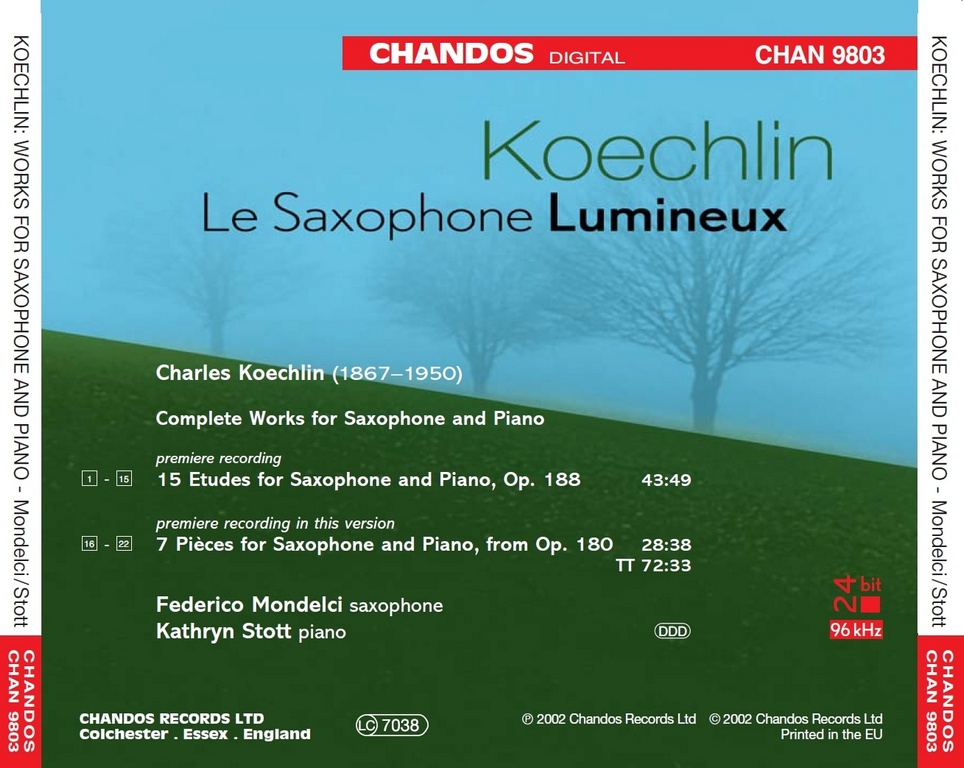
Koechlin: Complete Works for Saxophone and Piano


'Mondelci is equal to all Koechlin's demands (as usual with this composer, considerable) while Kathryn Stott matches him in fluency and accuracy.' --Gramophone

'Federico Mondelci has a warm, mellifluous tone which suits the predominantly lyrical nature of the repertoire perfectly and, partnered by the sensitive playing of Kathryn Stott, makes clear his obvious passion for these pieces.' --BBC Music Magazine


'Those perfect miniatures, superbly played by Federicao Mondelci with pianist Kathryn Stott… have an eloquence that is hauntingly potent.' --The Guardian

'He [Mondelci] rightly praises Kathryn Stott's empathy as accompanist… Chandos' warm, full acoustic captures this blend perfectly. Has the saxophone ever sounded more romantic?' --International Record Review

Chủ Nhật, 28 tháng 7, 2013

Bloch: 4 Episodes, 2 Poems, Concertino & Suite Modale


Bloch is of course best known for his “Jewish ” works…you can hear this in the finale of the Viola Suite, and perhaps most potently as the finale of the Four Episodes. Scored for piano, wind quintet, and strings, the performance here is wonderfully colorful and alive. Hiver-Printemps is one of Bloch’s earliest pieces, a pair of short tone poems that does exactly what the titles say: offer musical portraits of winter, and then spring. The style is impressionist, the scoring pellucidly lovely.


This is one of those discs that, by virtue of its unfamiliar repertoire, might easily be overlooked, but don’t make that mistake. You’d be missing excellent performances of very high-quality, enjoyable music… --ClassicsToday.com, July 2007

A fascinating and highly rewarding collection, involving two soloists, two orchestras and, in the case of the Four Episodes, scored (in 1926) for a combination of string quintet, wind quintet and piano. The most striking Episode is the well-named Humoresque macabre, while in the second, Obsession, Bloch spiritedly anticipates minimalism with the same five-bar motive repeated two dozen times, in continuous variation. The pastoral Calm, with its shepherd’s pipe, suggests nature, and the closing Chinese evocation is piquantly exotic. The Two Poems are earlier (1905) and are appropriately titled in French, for there is an atmospheric warmth and transparency to the scoring which has influences from both Debussy and Ravel. But perhaps the highlights are the two late concertante works; the charming three-movement Concertino for violin and viola (1948) ends with a fugue which then gives birth to a lively polka. The Suite Modale, with a serene ancient-and-modern flavour, was written in 1956, three years before the composer’s death—an engagingly nostalgic reverie, interrupted by a bright central Gigue. The performances here are excellent, all very persuasively directed by Dalia Atlas; they are splendidly played and given top-quality Naxos sound. A disc not to be missed. --Penguin Guide, January 2009 ***

Thứ Bảy, 27 tháng 7, 2013

Janácek: Orchestral Suites from the Operas Volume 1


“The extracts, expertly chosen by Peter Breiner, stand up reasonably well in the absence of the voices. They are nicely varied in character and pace, and are conducted by him with passion and sympathetic understanding.” --Gramophone Magazine, May 2009

“These are fine performances and stunningly dynamic recordings, with some fine low drum rumbles and plenty of sparkle and colour in the spectrum… if you want some refreshingly new orchestral music and an alternative view on Janácek then this is a very strong contender indeed.” --MusicWeb International


The operas of Leoš Janácek have been gaining their rightful place in major opera houses the world over.

First staged in 1904, Jenufa, a powerful tragedy set in a Moravian village, launched Janácek’s operatic career.

The Excursions of Mr Broucek, which had its première in 1920, is his most candidly satirical opera, rich in high jinks as the bumptious Prague publican travels to the Moon and back to the 15th century.

Peter Breiner, who created the compelling orchestral suites heard on this disc, conducts these world première recordings.

Thứ Tư, 24 tháng 7, 2013

Casella: Orchestral Works Volume 1


“...this is a remarkable and engaging work in its own right, with some striking features. In particular, the beautiful opening of the final 'Epilogo' is breathtakingly beautiful...the BBC Philharmonic and Gianandrea Noseda are both committed and convincing advocates in the premiere recording of this complex score.” --BBC Music Magazine, July 2010 ****

“This 50-minute would-be epic is given a splendidly forthright performance by Gianandrea Noseda and the BBC Philharmonic...[in the concerto] Martin Roscoe is a witty, trenchant piano soloist and the Chandos sound brings out all the piquancy of Casella's artfully un-18th century orchestration.” --Gramophone Magazine, August 2010


“Casella’s music isn’t too often heard here, but the BBC Philharmonic and its Italian maestro, Gianandrea Noseda, are trying to make a difference...Mahler is an evident influence, particularly in the fourth movement. Though styled a finale, it is followed by an Epilogo of hushed beauty, building to a massive, affirmative, organ-buttressed close.” --Sunday Times, 11th July 2010 ***

“[Scarlattiana] receives, of course, a glorious and poetic performance, with the added luxury of Martin Roscoe's participation...anyone with more than a passing interest in this fascinating composer needs to have this remarkable disc.” --International Record Review, July/August 2010

“...under Noseda’s guidance there is cohesion, drive and passion, and the playful Scarlattiana (1926) reveals Casella’s spirited allegiance to the clarity and perkiness of neo-classicism.” --The Telegraph, 13th June 2010 ***

Shchedrin - Concertos for Orchestra Nos. 4 & 5


All three works on this disc are world première recordings.

“It is above all [Shchedrin's] ear for orchestral colour that dominates...[his] gift ensures that the ear is constantly beguiled...Karabits and the Bournemouth Symphony Orchestra do brilliantly with it all, and so, crucially, do the recording engineers in capturing all the delicate and original sounds.” --Gramophone Magazine, August 2010


This disc marks the start of a long collaboration between Naxos and the Bournemouth Symphony Orchestra’s new young Ukranian conductor, Kirill Karabits.

The distinguished Russian composer, pianist and teacher Rodion Shchedrin writes: “I spent my childhood in the small Russian town of Aleksin, situated on the river Oka, 300 kilometres south of Moscow. When I was growing up, purely entertaining, commercial music was not yet as ubiquitous as it is now… It was still possible to hear choral songs, the sound of the accordion, the strumming of the balalaika, funeral laments, the cries of shepherds at dawn, coming from beyond a river, enveloped in fog. All that distant and now extinct musical atmosphere of a Russian province is strongly etched in my childhood memories. I think, in all three compositions on this CD, it has found it own nostalgic echo.”

“Karabits demonstrated an impressive, riveting range of sensibility and sensitivity to musical style… The Bournemouth Symphony Orchestra was on top form and receptive to his interpretative ideas.” Concert review by The Daily Telegraph

Thứ Bảy, 20 tháng 7, 2013

Arthur Benjamin & Leighton Lucas: Film Music


 “...Gamba directs first-rate performances of these works, all of which are played with electrifying panache (the brass in particular impress throughout) and attentiveness by the BBC orchestra. The recording itself, made in October 2011 at the orchestra’s acoustically inviting new home, Hoddinott Hall, Cardiff, is predictably rich, detailed and spacious. This is another hugely enjoyable addition to this consistently top-drawer Chandos series. Unhesitatingly recommended.” --International Record Review, April 2012


"...As with all the Chandos Film music series discs this is a superb achievement. When one bears in mind that most of the music presented here has been arranged, transcribed or written down from hearing the soundtracks one realises just how much work has gone into making this CD the success it is. All the music is beautifully played by the BBC National Orchestra of Wales and their conductor on this occasion, Rumon Gamba. This selection of tunes is surely a good distillation of the full film scores. The sound quality is excellent. As always the sleeve-notes are excellent...One can only hope that this CD will encourage performers and record producers further to explore the music of Arthur Benjamin and Leighton Lucas. A superb achievement. Beautifully played." --Musicweb-International.com, April 2012

“here's British film music for every occasion, with seven samples of Lucas (usually refined, sometimes limp) and a meatier trio by Benjamin.” --BBC Music Magazine, May 2012 ***

“The strengths of the recording are immediately apparent - richly heraldic brass and secure warm strings” --MusicWeb International, May 2012

Spirit of Brazil


“…there are gems such as the successful arrangement of Villa-Lobos's Bachianas Brasileiras No 5 by former Aquarelle member Richard Safhill, and the incredible six-movement Brésils by Roland Dyens, in which the AGQ manage convincingly to sound like an Amazonian rainforest and a marching band at the Carnival de Rio. Guitarquartetophobes - your cure has arrived!” --Gramophon, May 2009

“With outstanding playing an infectious spirit, this is no mere niche guitar CD, but a luscious and lively general-appeal winner.” --BBC Music Magazine, June 2009 *****


“If one guitar quartet can give a traditional string quartet a run for its money in terms of abundant technique and breathtaking artistry, it is the Aquarelle Guitar Quartet” --INternational Record Rewiev, June 2009

“…this is the best Brazilian program I’ve heard in quite a while.” --American Record Guide