Hiển thị các bài đăng có nhãn Rimsky-Korsakov Nikolai. Hiển thị tất cả bài đăng

Thứ Bảy, 6 tháng 7, 2013

Glinka: Grand Sextet; Rimsky-Korsakov: Quintet


‘Some of the most joyously delightful music that you will ever hear’ --American Record Guide

‘Rimsky’s youthful quintet is a thoroughly diverting piece … like a garrulous but endearing friend whose loquacity is readily borne for the sake of his charm and good nature’ --Penguin Stereo Record Guide


‘Two delightful rarities --The Musical Times

‘Captivating’ --Hi-Fi News

'A most striking performance, beautifully modulated, elegantly phrased... very well recorded indeed' --BBC Record Review

Thứ Năm, 8 tháng 11, 2012

Rimsky-Korsakov: Golden Cockerel Suite, May Night Overture, Etc


"In these days of big boxes, DG really ought to gather together everything Markevitch did and issue it as a set. He was a genius, and his recordings with the Lamoureux Orchestra, especially, combine interpretive brilliance with a classic French instrumental style that no longer exists. They are irreplaceable, and the playing here is amazing. Rimsky-Korsakov’s music demands just the sort of diamond-like precision and clarity that was Markevitch’s stock in trade as a conductor.


There are more raucous, more traditionally Russian versions of The Golden Cockerel Suite available (Järvi’s for example), but none that point up the music’s anticipations of Stravinsky so compellingly. Both here and in the May Night Overture, Rimsky-Korsakov becomes a prophetically modern master.

Markevitch recorded Francesca da Rimini for Philips with the New Philharmonia (Philips), but that performance, good as it is, doesn’t compare to this one in terms of spontaneity and sheer ferocity. I think many listeners in the English speaking world were brainwashed into thinking that performances with British or American orchestras enjoyed a natural superiority in head to head comparison with French orchestras, which were often described as inherently second rate. That was just nationalist propaganda. Compare the coda of Francesca in Markevitch’s two peformances (sound clips), and judge for yourself which orchestra delivers maximum ferocity at a blazingly quick tempo. This is one of the great Francescas, a work that so often suffers both live and on disc.

The rest of the program is just plain delightful. In the Steppes of Central Asia benefits from those characterful French woodwinds, Ruslan and Lyudmila from the kind of disciplined ensemble that makes the tempo sound quicker than it actually is, while Liadov’s From the Apocalypse makes a brilliant encore. DG’s 1959/60 sonics still sound amazingly fine, and suit the performances ideally. This is a great collection–78 minutes of fabulous, inimitable music-making." --David Hurwitz, ClassicsToday.com


Thứ Tư, 12 tháng 9, 2012

From Russia with Music


It is quite enjoyable to hear the National Philharmonic of Russia performing compositions by the country's musical heroes, and Vladimir Spivakov does a first-rate job of conducting. The first treat is Rimsky-Korsakov's "The Three Wonders," a march from the opera Tsar Sultan, which is beautiful, sparkly, and simply wondrous in the high registers. The flute and harp passage is ethereal, the strings are vast and singing, and each nuance of feeling is conveyed.


The much beloved fantasy overture Romeo and Juliet is Tchaikovsky's contribution to the album. The music builds in urgency, with fast passages played with great energy and vigor, and there is much emotion, as is fitting for the tale of the star-crossed lovers. The famous love theme is first heard in the low strings in a most elegant and restrained fashion, but when it returns it is full and lush: one can hear all the details, like the triplets under the strings. The string instruments play with perfect attacks and they are full of punch when necessary.

This is an orchestra that is perfect and precise with its timing, but its artistry is what captures the listener. Rachmaninov's Symphonic Dances, Op. 45, are each unique. The first features violently bowed passages and very 20th-century harmonies, while the second is a lovely waltz with more interesting tonalities than 19th century waltzes in its lush orchestration. The orchestra's sense of timing and tension within the lines here is superb. The third dance is moody yet bright at the beginning, and the piece has a fairytale-like quality, a rather programmatic feel. The concluding work is Three Russian Songs for Chorus and Orchestra, Op. 41, and Rachmaninov truly gets wonderful colors out of the orchestra that complement the voices.

Particularly enjoyable are the very modern-sounding string melody and harmonies in the first song, and the almost reverential quality of the second song: there is none of Rachmaninov's over-the-top Romanticism here. The last song is haunting with a march-like, militaristic feel; brief and austere, there are echoes of Carmina Burana not likely to escape the listener. Spivakov and his orchestra give a marvelous performance. The treble is certainly favored on this recording, which is sometimes advantageous and sometimes not. Another criticism of the recording quality is that the sound is rendered a bit flat, needing more ring or reverb. --allmusic.com

Thứ Sáu, 7 tháng 9, 2012

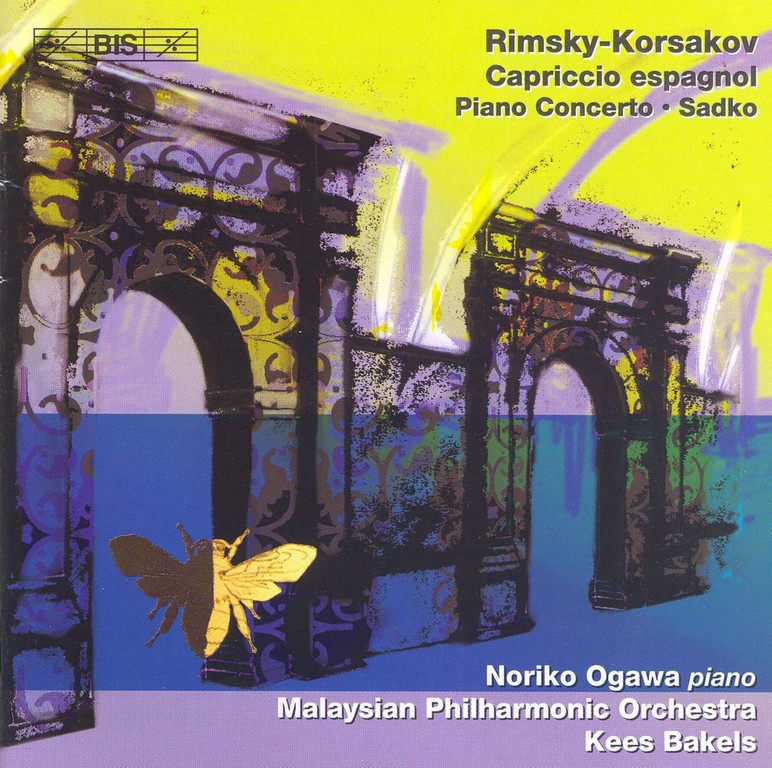
Rimsky Korsakov: Capriccio Espagnol, Piano Concerto, Sadko


On their previous Rimsky-Korsakov disc, Kees Bakels and the Malaysian Philharmonic Orchestra gave us their interpretation of the ever popular Sheherazade – a 'particular joy' according to the critics – coupled with the less well-known Second Symphony. On this disc the favourites include the Capriccio espagnol and Flight of the Bumble-Bee, unusually presented in its context as the third movement of an orchestral suite from the opera The Tale of Tsar Saltan.


At least as attractive is the Russian Easter Festival Overture, dedicated to the memories of Mussorgsky and Borodin; the composer's final large-scale orchestral piece. Based on Russian liturgical themes it progresses from a solemn pre-Easter processional, through the discovery of Christ's empty tomb, to the joy and triumph of the Resurrection.

Another work that definitely deserves to be better known is the Piano Concerto. Within its short time-span it daringly explores a wide range of expressive possibilities which Noriko Ogawa and the orchestra exploit to the hilt.

Thứ Bảy, 2 tháng 6, 2012

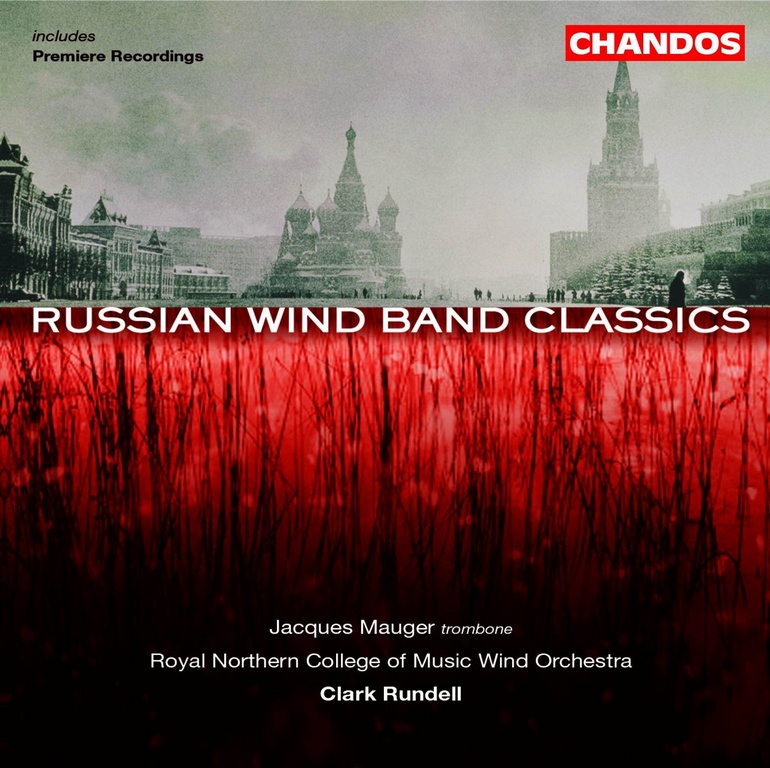
Russian Wind Band Classics


'The Chandos recording has immediacy, good dynamics, and rich Tutti band sonorities. Band music fans definitely need to check this one out.'  --Fanfare

'..the performances get the thumbs up. Chandos' recording engineers have done their work with the necessary bravado.' --International Record Review


'Stravinsky's Circus Polka, Prokofiev's brilliantly balletic Marches for Military Band and a suite from Khachaturian's score for the film The Battle of Stalingrad complete a disc that is as enterprising in repertoire as it is spirited and polished in performance.' --Telegraph

'The band sound truly stunning in the best moments of the score, even through the more hard-driven sections, and on the whole the performances on this disc are highly recommendable. They possess a more transparent and flexible sound than the Stockholm band under Rozhdestvensky, and their trademark lightness (especially noteworthy in the percussion) and crisp articulation give this programme a wonderful shine. If your tolerance for marches and Socialist Realist music is high enough, this could be an enjoyable excursion after all.' --DSCH Journal

'The playing of the RNCM Wind Orchestra is of the highest quality, it's hard to imagine any group could have done it better. Another quality product on the Chandos label' --Brass Review

MP3 320 · 150 MB

Chủ Nhật, 29 tháng 4, 2012

The Enchanted Kingdom


A collection of exotica in the fantastic Russian fairy-tale tradition. Tcherepnin is a Fabergé in sound. Liadov also deploys sizeable forces with exquisite delicacy. --BBC Music Magazine. Performance: ***** / Sound: *****

"This collection of exotica written in the fantastic Russian fairy-tale tradition benefits from the superior tone and ensemble of an orchestra founded as recently as 1990. With silky strings and characteristically Russian wind, its virtuoso approach and the detail of Pletnev’s interpretations show the music’s hyper-refinement and fastidious use of colour to advantage.


The great rarities here are the pieces by the composer and conductor Nicolai Tcherepnin (1873-1945), a pupil of Rimsky-Korsakov. His languid La princesse lointaine derives from a verse play by Edmond Rostand about a knight dreaming of an oriental princess, while Le royaume enchanté depicts the magical kingdom of Kashchey – stamping ground also of Stravinsky’s contemporaneous Firebird. With Tchaikovskian clarity, and heady harmonies akin to Scriabin, the minuteness of Tcherepnin’s writing marks him as a Fabergé in sound, though the three orchestral miniatures by Anatol Liadov (another Rimsky pupil) are scarcely less remarkable in deploying sizeable forces with exquisite delicacy.

Amidst all these epicurean sweetmeats, the suite drawn from Rimsky-Korsakov’s satirical final opera seems plainer fare than usual, though its glittery brilliance registers keenly in the recording’s wide range of colour and dynamics. --BBC Music Magazine.

MP3 320 · 145 MB

Thứ Tư, 11 tháng 4, 2012

Rimsky-Korsakov: Sheherazade, Etc.


Rimsky-Korsakov’s Sheherazade is a colorful and powerful score, and many conductors have done it well, but this one goes over and beyond. Each phrase grabs you. The orchestra is technically and emotionally superb. This is a real sonic feast for the ears—spectacular, explosive, electrifying! The pairing is equally vivid and expressive. This is a proof that the great names of the past still can be beaten! --MusicWeb International


Gerard Schwarz and his Seattle forces turn in an absolutely terrific Sheherazade: voluptuous, exotic, with a nice flexibility of pulse, but also very exciting. You can tell this will be a fine performance from the very first bar: firm and strong, with the brass giving the theme a menacing growl, followed by Maria Larionoff’s bewitching solo violin representing the protagonist herself. Only the finale, while admirably fleet and precise, lacks a touch of cinematic sparkle, but when everything else goes so well this is a minor point. The two inner movements in particular have a crispness and flow that are very welcome, and (these days) somewhat unusual.

The Tsar Saltan Suite is just plain spectacular—as colorful and brilliant as you could imagine. Its central movement, “The Tsarina in a Barrel at Sea”, is particularly gripping: the strings really dig, the accompaniment throbs, and the entire movement has an emotional impact that most performances barely begin to suggest. Through it all the orchestra plays with one hundred percent commitment, and the sonics, just a shade dry, offer maximum clarity. This is the first disc in a projected series, and if it maintains this standard it will be a high point in the extensive Schwarz/Seattle discography. --David Hurwitz, ClassicsToday.com, February 2011

MP3 320 · 143 MB


Thứ Sáu, 23 tháng 3, 2012

Rimsky-Korsakov: Great Orchestral Works


These two discs have brought together almost all the pieces conventionally used as fillers after recordings of Sheherazade. But in the absence of the masterpiece itself, this music, for all its exotic orchestration and easy tunefulness, has something of a second division feel about it. The flamboyant Capriccio espagnol is naturally excluded from such a sweeping generalisation.


The Tsar Saltan Suite (which sensibly but improperly includes ‘The Flight of the Bumble-bee’) is unusually rich and atmospheric in this performance, as is Antar (or Symphony No. 2), whose haunting motto theme has been following me around ever since. -- BBC Music Magazine

2 CD · MP3 320 · 305 MB

Chủ Nhật, 18 tháng 3, 2012

Tchaikovsky: 1812, Marche Slave · Rimsky-Korsakov, Borodin: Orchestral Works


"Järvi's 1812 is exciting - and not just for the added Gothenburg brass and artillery or for the fervour of the orchestra at the opening. He clearly knows the histrionics, and so do we.” " --Gramophone


Tchaikovsky didn't much care for the 1812, preferring the Serenade for strings which he was composing at the same time. In fact, as Jarvi shows, the Overture is a very professionally structured piece which effectively combines national patriotic and folk melodies from which the composer generates a really thrilling ending.

Jarvi's is a very musical reading, broadening nicely for the folksy lyricism, yet keeping up the flow of adrenalin. Besides the very impressive cannon of the Gothenburg Artillery and carillon, the Gothenburg Symphony Chorus make a very considerable contribution at the opening, singing the Russian hymn sonorously and affectingly and then producing a burst of fervour before the orchestra takes over. It rejoins the fray at the very end, but is rather too backwardly balanced here. This is a comment rather than a serious criticism: it must be almost impossible electronically to intertwine orchestra, bells, pre-recorded cannon and chorus, and please all ears. Generally, the engineers do a very good job. The overall effect is both exciting and genial.

Then comes a strong account of the Marche slave, with just the right touch of solemn melancholy in the opening paragraphs to balance the exultant ending. Borodin's In Central Asia is one of the most memorably poetic of all Russian orchestral evocations. It has two marvellous tunes, one used to create atmosphere and at the same time suggest movement, and the second ravishingly sinuous, able to combine with the first quite perfectly as the oriental caravan draws near.

The Polovtsian Dances alas, omit the opening percussion-led ''Dance of the Polovtsi maidens'' and begin at the ''Flowing dance''. Otherwise we are given a first-rate performance, with the chorus splendidly balanced and providing some lovely lyrical singing and a climax of considerable fervour (if not quite as unbuttoned as some versions, notably Beecham on EMI). But this is very enjoyable and in the ''General dance'' (the one with the bass drum) there is a surprise. What appears to be a brief solo from the Khan is sung by a member of the chorus, rather effectively reminding us that we are in the opera house rather than the concert hall.

Rimsky-Korsakov's Russian Easter Festival Overture is an episodic, loosely structured piece that can too easily fall apart. It doesn't here and most important, Jarvi propels everything forward without pushing too hard. The performance of the Capriccio espagnol has great zest and brilliance. The opening is faster than the recent Mackerras Telarc/Conifer version, and when the ''Alborada'' returns with great dash, after the colourful variations, one wonders if it isn't a trifle too fast. But the closing ''Fandango asturiano'' and the exciting lead up to it—with splendid bite and attack from strings and brass alike—create much exhilaration. All in all this concert can receive the strongest recommendation. The overall playing time is very generous indeed.
-- Ivan March, Gramophone [3/1991]

MP3 320 · 163 MB