Hiển thị các bài đăng có nhãn Mozart Wolfgang Amadeus. Hiển thị tất cả bài đăng

Thứ Bảy, 21 tháng 9, 2013

Mozart Opera and concert Arias


“Diana Damrau's intelligently planned and superbly executed recital… I can’t remember when I last enjoyed a Mozart recital of this kind so much.” --BBC Music Magazine, December 2008 *****

“…Jérémie Rhorer draws tangy, rhythmically lively playing from his period band. "Taste", "fire", "flexibility", "sweetness", "grace of execution" - these were the qualities especially prized in singers of Mozart's day. On this showing Damrau, like Lucia Popp before her, has them all.” --Gramophone Magazine, March 2009


Diana Damrau (soprano)
Le Cercle de l’Harmonie, Jérémie Rhorer

In her second recording as an exclusive Virgin Classics artist Diana Damrau interprets concert and operatic arias by Mozart in a programme which displays her virtuosity and impressive vocal range.

Indeed Diana Damrau’s new recital shows she can sing practically all of Mozart’s notably varied soprano roles – ranging from the bravura (Donna Anna, Konstanze, Donna Elvira…) via the more serious (Pamina) to the lighter soprano (generally soubrette roles such as Susanna, Blonde…).

From her first recording everyone noted her outstanding Queen of the Night – here she is Pamina (in New York’s Met last Fall, Diana Damrau alternated the two roles with brio). She is also Susanna and the Contessa (Le Nozze di Figaro), Konstanze and Blonde (Die Entführung), Donna Anna and Elvira (Don Giovanni), Servilia and Vitellia (La Clemenza di Tito), pairing major soprano roles within the operas, and concert arias.

As for her first recital, ‘Arie di bravura’, French conductor Jérémie Rhorer, who is rapidly gaining international recognition, directs his French period-instrument ensemble Le Cercle de l’Harmonie

Thứ Sáu, 20 tháng 9, 2013

Mozart: Piano Concertos Nos. 17 & 27


“[Hewitt] weights the finale [of K491] to reflect rumination or melancholia, and propounds it supremely well too...Yet the Andante evokes the finest in her, its trajectory exposed through pathos and proud gesture.” --Gramophone Magazine, June 2013

“Hewitt displays her pianistic talents to full advantage. Particularly enjoyable are the concluding variations, with their opera buffa-style coda, in which she seems completely at one with the alert playing of the Mantua Chamber Orchestra under Hannu Lintu.” --BBC Music Magazine, August 2013 ****


“[the Presto of K453] is brilliantly done, anmd this is a brilliant performance all round.” --International Record Review, May 2013

“The sound is wonderfully clean and focused, with an ideal balance between Hewitt’s customary Fazioli piano and the orchestra...a Mozart release to cherish.” --The Telegraph, 10th May 2013

Angela Hewitt turns to two of Mozart’s greatest and most popular concertos for her latest album. Together with her frequent collaborators, the Orchestra da Camera di Mantova and brilliant Finnish conductor Hannu Lintu, she presents these works in performances which are both elegantly stylish and profoundly felt. This release is completed by a personal reflection on the music by Hewitt herself in the accompanying booklet.

Chủ Nhật, 25 tháng 8, 2013

Mozart: Clarinet Concerto & Clarinet Quintet


“Better recorded performances of these towering masterpieces may exist, but I have never heard them. In their technical proficiency, style consciousness and broad, yet never exaggerated emotional range, they shine as major achievements.” --International Record Review, 2011 edition

“Martin Fröst plays Basset clarinet with the extra low notes of Mozarts presumed orginal version and succeeds in getting them unusually well in tune.His light,lively approach to the outer movments and his inward but not over-solemn reading of the Adagio are well matched by the chamber-sized Amsterdam orchestra.” --BBC Music Magazine, nov 2003


In the liner notes to this disc, Swedish clarinetist Martin Fröst is described as a “daring performer” who has “stretched the limits of musical expression”, likely owing to his frequent collaborations with several contemporary composers including Anders Hillborg and Krzysztof Penderecki. “Daring” does not leap to mind when describing Mozart, and happily Fröst himself does not flaunt his presumed reputation when tackling these popular works. While some may find Fröst’s readings on the “cool” side, it is largely because they are just so perfectly executed and pristine that you are left hopelessly grasping for something that might be missing. After all, what ultimately determines Mozartian performance standards but the expectation of technical perfection? In no small part aided by the redoubtable Amsterdam Sinfonietta and Vertavo String Quartet, Fröst steals the show with his sultry tone, sensitive phrasing, and utterly beguiling pianissimos, momentarily making us forget that several other great performances of the Concerto have graced the catalog for decades. - See more at:

Thứ Năm, 15 tháng 8, 2013

Mozart: Concertos K 242, 365, 466 (2 & 3 Pianos)


This reissue offers one major work, the Piano Concerto in D Minor, coupled with recordings of pieces that I would guess musicians like to play for the sheer, uncomplicated fun of it: the concertos for two and three pianos. (All the concertos here were recorded in 1989.) The three-piano work was written for an aristocratic patron, Countess Maria Antonia Lodron, to play with her two daughters. The problem was that daughter number two was evidently not a good pianist, so Mozart wrote a particularly simple part for Giuseppa (played here by Georg Solti).


 The two-piano concerto was written so that Mozart himself would have a piece to play with talented Viennese students. It’s a more sparkling work, but neither piece, however good-natured the composer’s intentions, ranks that high in Mozart’s œuvre. That said, they both are treated respectfully and played well by Georg Solti and his two auxiliary pianists, who make the Adagio of the Three-Piano Concerto more touching than I’ve heard it before.

It’s charming to hear the measures of that concerto that Mozart wrote for his least-talented patron, but it also reminds me that some of Mozart’s greatest moments, even in the Piano Concerto in D Minor, come in passages a pianist could play with two fingers, such as the four quarter notes in measure 49 of the Rondo of this piece, which Rubinstein plays as written to incomparable effect and which Solti decorates. I have always thought that the sublime simplicity of those notes was the point: Solti sees them as a sketch. Still, his is a wonderful recording by a man who is obviously an important conductor and a fine pianist. This is not my favorite recording: there are others starting with Schnabel and Rubinstein. Yet orchestra and pianist play beautifully together, Solti with energy and drive.

-- Michael Ullman, FANFARE

Chủ Nhật, 7 tháng 7, 2013

Mozart: Violin Concertos Nos. 3 & 5


“These are bright, lively performances, on modern instruments but well aware of 18th-century style. The finales of all three works are especially successful..Tognetti and Moore are wonderfully well-matched, and when they play together in parallel their tones make a perfect blend.” --Gramophone Magazine, February 2011

“When Mozart presents a statement on one instrument and repeats it on the other, their phrasing is perfectly matched; similarly, when they play together, they blend effortlessly. It's like listening to chamber music.” --Classic FM Magazine, April 2011 ***


“This is a wonderfully refreshing Mozart disc...Tognetti's phrasing is stylish, imaginative but never eccentric, and the orchestral accompaniment is played with an alertness and care over rhythms that produce results that are notably tidy as well as scrupulously shaped....Tognetti's ornamentation and embellishment feel just right too.” --International Record Review, December 2010

“Just a few bars of the neatly sprung opening tutti of Mozart's G major violin concerto K216 are enough to confirm...the tremendous energy and sense of musical purpose that are so characteristic of the Australian Chamber Orchestra and their leader Richard Tognetti...These are modern-instrument performances of great personality and emotional generosity.” --The Guardian, 18th November 2010 ****

“It’s not easy being graceful one minute, punchy the next, but the Australian Chamber Orchestra, equipped with gut strings and other period habits, manages with ease on this gripping disc. The cake’s icing is Tognetti...Phrasing and speed control are fresh and thoughtful, cadenzas weighty, textures unfailingly clear. Delightful music-making.” --The Times, 27th November 2010 ****

“Tognetti is in total control both as leader and soloist in beautifully nuanced performances of the third and fifth violin concertos...Tuning to a warmer A=430 (rather than standard 440) and using gut strings, they produce a gloriously exciting, tangy edged, alert and playful sound.” --The Observer, 26th December 2010

Thứ Tư, 3 tháng 7, 2013

Mozart, Copland & Kats-Chernin: Works for Clarinet & Orchestra


“... In recent efforts, Collins has cultivated a cleaner sound to accompany his always impressive musicianship and technique, and his playing here is some his best. His timbre is clear and resonant, and while it naturally has a touch of British flavour, it is disciplined and colourful. The Mozart is beautiful, perceptive, and breathtaking; the Copland is intimate and exuberant; and the Kats-Chernin is urgent an raucous. His expressive risk-taking is enjoyable, too, from the joyful decorations in the Mozart to the sassy pitch-bending in the Kats-Chernin... The Swedish Chamber orchestra plays with seemingly effortless aplomb and professionalism, no matter the composer or the century.” --American Record Guide, May/June 2013


“...Throughout, Michael Collins is in his element, relishing every twist and turn of the music’s consistently imaginative invention ... Michael Collins is just as at home here [Copelands’s Concerto] as he is in the Mozart and Kats-Chernin, directing the Swedish Chamber Orchestra with idiomatic panache.” --Gramophone magazine, March 2013

 “...Collins is better integrated with the orchestra than virtually any of his predecessors ... The sense of spontaneous, organic interplay between clarinet and orchestra is most welcome ... Few recordings on either period or modern instruments manage this interplay as well – and few orchestras, period or modern, manage a collective sense of phrasing as convincing as the Swedish Chamber Orchestra here, making this a strong recommendation. The ravishing opening pages of the Copeland are given their full quota of swoon and the collective phrasing of the orchestral strings is consistently excellent - again the chamber-music qualities of this performance are a particular delight... Collins proves a strong and committed advocate for the work...” --International Record Review, January 2013

Thứ Sáu, 14 tháng 6, 2013

Mozart: Violin Concertos Nos. 1 & 3, Sinfonia Concertante


“These musicians have all the hallmarks of excellence and it's impossible not to be drawn to their empathy with the rhythmic vivacity and finer sensibilities of the music.” --Gramophone Magazine, July 2009

“The First Concerto's opening tutti sets the overall tone of this disc with bright and light phrasing. Renaud Capuçon's… vibrato is tight, never becoming sickly, and he spins an elegantly effortless line in the slow movement, with a wide variety of tone colour.” --BBC Music Magazine, August 2009 ***


“Capuçon is partnered by the viola player Antoine Tamestit, who perfectly complements his unfailingly musical phrasing without ever slavishly copying it. A fine achievement.” --The Guardian, 17th April 2009 ****

“His performance here is lithe, graceful and refined, capturing vivacious humour with luminous upper-stringed sparkle, and colouring the slower movements with warm, musical poetry...There is real artistic synergy here: each matches the others gentle poise and warmth, with the velvety depth of the viola setting off the sweet descant of the violin.” --Charlotte Gardner, bbc.co.uk, 21st May 2009

Thứ Bảy, 8 tháng 6, 2013

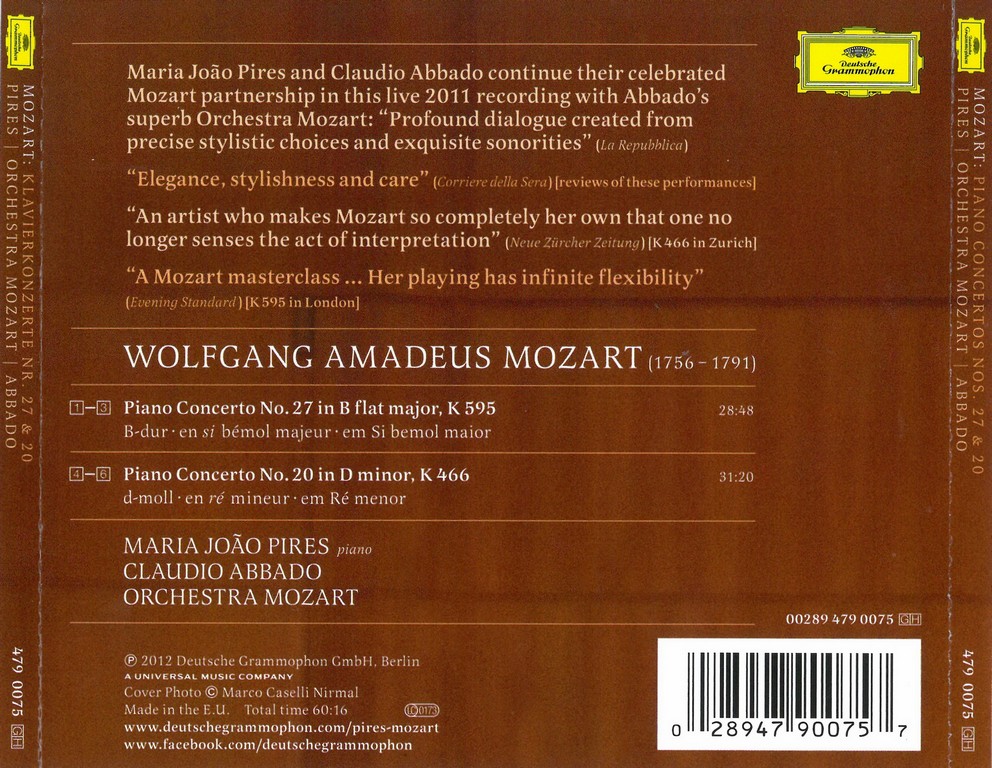
Mozart: Piano Concertos Nos. 27 & 20


“The conducting is intelligently alive, in quality reminiscent of Benjamin Britten...Pires enters into the prevailing mood, her artistry as thougthful as yore...Pires shows that expressive sensitivity isn't confined to a slow tempo...Reduced forces might have enhanced the concerto's intimate character. It's a small point. These absorbing, penetrating performances deserve the widest currency.” --Gramophone Magazine, January 2013


“it is the autumnal Concerto No. 27...that is perhaps better suited to the understated poetic eloquence of Maria Joao Pires's playing than the more overtly dramatic Concerto No. 20...Abbado and his Orchestra Mozart offer fine support in both Concertos, and the performances as a whole have an elegance that cannot fail to give pleasure.” --BBC Music Magazine, January 2013 ****

“From the first moment, the performance has a quality that characterizes the entire recording: a perfect balance between musical, textural and rhythmic precision and all of the mood and atmosphere that the music requires” --International Record Review, December 2012

“[K595] has a strange, veiled, ethereal quality, an air of difference from the others, well brought out by Pires, with Abbado and his fine players. By contrast, the opening of the D minor sounds rather tame...The other two movements are much more convincing.” --Sunday Times, 16th December 2012

Thứ Ba, 30 tháng 4, 2013

Mozart: Great Piano Concertos Nos. 16, 24, 25, 26 & 27


Andras Schiff's Mozart cycle with the Camerta Academica des Mozarteums Salzburg and Sándor Végh was recorded between 1987 and 1993 and quickly came to be recognised as one of the finest cycles to be recorded during the digital era and using modern instruments.

This 2-CD set focuses on the last 4 concertos with the addition of No.16 (K451) and provides an excellent selection of concertos drawn from the complete cycle.


As well as a useful catalogue item and strong addition to the DOUBLE DECCA catalogue, this set also acts as a superb reminder of Andras Schiff's wonderful Mozart interpretations as he approaches his 50th birthday on 21st December 2003.


Thứ Sáu, 26 tháng 4, 2013

Mozart: Flute Concertos


"To both concertos plus the two separate movements...Bezaly brings pure, delicately coloured tone - beautiful throughout it's range - phenomenal agility and breath control, and an impish sense of fun." --Gramophone

“Bezaly's exquisite, technically immaculate, compelling playing sets new standards in this repertoire, as do Kalevi Aho's stunning cadenzas, composed especially for this recording” --BBC Music Magazine


“Israeli flautist Sharon Bezaly offers delectable performances of the familiar Mozart concertos. The composer famously protested that he loathed the flute, though he was far too much of a pro to slip from his customary fastidious standards.

In the fast movements he is at his most puckish and insouciant, while the slow ones, especially the Adagio ma non troppo of the G major, infuse graceful galanterie with exquisite poetry.

To both concertos, plus the two separate movements (of which the D major Rondo is a transcription of the dapper C major Rondo for violin, K373), Bezaly brings pure, delicately coloured tone – beautiful throughout its range – phenomenal agility and breath control, and an impish sense of fun. The Allegros have an elegant bounce, with soloist and the ever-alert Ostrobothnian Chamber Orchestra relishing their quickfire interplay. Repeats are always a cue for imaginative new phrasings; and time and again Bezaly provokes a smile with her playfully varied bravura passagework.

Bezaly opts for a lighter tonal palette than usual and favours a cooler, simpler (and arguably more Mozartian) approach in slow movements.

Where she steps right out of period is in the cadenzas. Specially written by Kalevi Aho, these refract and fragment Mozart through a 21st-century prism, exploiting the whole compass of the flute and giving Bezaly scope to explore intriguing new colours. Purists may throw up their hands. But if you can adjust to the time-travelling you may find Aho's cadenzas ingenious, entertaining and strangely touching.” Gramophone Classical Music Guide, 2010 (Mozart - Complete Works for Flute and Orchestra)

Thứ Tư, 17 tháng 4, 2013

Mozart: Horn Concertos


“Allegrini’s [sound] is a marvel – mellifluous, supple and ripe...Fluency and expressive grace are equal partners here. Abbado is ever-ready with a pertinent orchestral comment, an apt emphasis or a perfectly tailored phrase. Allegrini radiates the music’s joy, lyrical allure and poise...A hugely enjoyable disc.” --The Telegraph, 18th August 2011

“[Allegrini] is certainly a suave instrumentalist, while once again Abbado conducts with a wonderfully light touch. The orchestra and Allegrini all play modern instruments, but there's a period sensibility about the way the textures are balanced and the phrasing shaped.” --The Guardian, 18th August 2011 ****


“In tune with Claudio Abbado’s bracing “new-old” approach to Mozart — sparing use of string vibrato, astringent, wind-dominated textures — Allegrini’s slightly rougher-edged way with this famous music could hardly be less like Brain’s suave cantabile. Especially in the “hunting call” allegro finales, the two Italians bring a rude, rollicking alfresco quality” --Sunday Times, 21st August 2011 ****

“[Allegrini's] tone is full but flexible, sustained but lyrical, and he manages to impart a certain wistfulness to even the jolliest rondos...The orchestra...throughout, is a model of sophistication.” --The Observer, 21st August 2011


Chủ Nhật, 31 tháng 3, 2013

The Very Best Of Mozart


Naxos’s two-disc collection, The Very Best of Mozart, includes a generous selection of music by the prolific eighteenth century Austrian composer. The only works that are presented complete are the pieces in a single movement, and the album is made up mostly of individual movements from larger works. The set includes a variety of pieces from the many genres of which Mozart was a master, including symphony, opera, church music, serenades, orchestral music, keyboard music, and chamber music. 


The tracks are taken from CDs from Naxos’ archives. Most of the performances are serviceable and the sound quality is adequate. The program notes don’t list the performers but instead point the listener to Naxos’ website for full information about each track. --Allmusic.com, December 2010

Thứ Sáu, 1 tháng 3, 2013

Mozart: Concert Arias


Mozart's concert arias are not really generically independent from his operas. They were mostly written for insertion into operas by a singer, often Mozart's girlfriend and then sister-in-law Aloysia Weber, who wanted to display her talents to their best advantage. As such, however, they stand out from other operatic arias as some of the most difficult vocal pieces Mozart composed. Several of these pieces are in Queen of the Night territory, with not just individual high notes but lengthy passages that require the singer to be melodic at the very top of her range.


This 1994 release by French soprano Natalie Dessay, just hitting the very top of her game, has been a favorite among aficionados of Mozart's vocal music, and its reissue in Virgin Classics' budget line gives other listeners a chance to try it out. For sheer agility in the top register, it's hard to beat. Dessay not only hits the multiple examples of the E two octaves plus above middle C, she sounds good doing so, and she makes real music as the tune bounces around a few steps below that. There are sopranos with greater dramatic insight than Dessay, and plenty with more sheer power, but for the pleasure of hearing a trained voice enter territory where only a few can go, this disc remains a rare find.

The Lyon Opera Orchestra under Theodor Guschlbauer stays out of Dessay's way, which is exactly the right place for it. The booklet notes, in English, French, and German (the French and German notes are different from the English but identical to each other), are abbreviated from the earlier release; there is no biographical information, but the basic background on the music is helpful. No texts are given, but when you hear Dessay hit the stratosphere, you won't care. --by James Manheim. allmusic

Chủ Nhật, 17 tháng 2, 2013

Mozart: Divertimento in E flat major


“I do not think that Mozart's K563 has ever had a finer performance on record than this. The balance between the instruments is ideal and the realization of the part-writing is, in a word, perfect...with the consequence that the profound quality of the music is at all times conveyed...a superlative achievement which I cannot imagine ever being improved upon.” --International Record Review, March 2011


“Mozart’s arrangements of Bach make an apt frame for one of his divertimentos. The warmth and bloom on this recording by the Hermitage Trio is immediately inviting, and the player’s incisive, well-considered readings of Mozart’s trios are a treat...” --Catherine Nelson, The Strad, March 2011

"Many hours of supreme musical pleasure are guaranteed." --John Sheppard, MusicWeb-International, February 2011

Thứ Hai, 5 tháng 11, 2012

Mozart: Piano Sonatas K311, K457, K570; Fantasy K475; Adagio K540


Vladimir Ashkenazy, piano

Wolfgang Amadeus Mozart (1756-1791)
Fantasie in C minor, K475
Sonata in B flat major, K570
Sonata in C minor, K457
Adagio in B minor, K540
Sonata in D major, K311


Thứ Sáu, 26 tháng 10, 2012

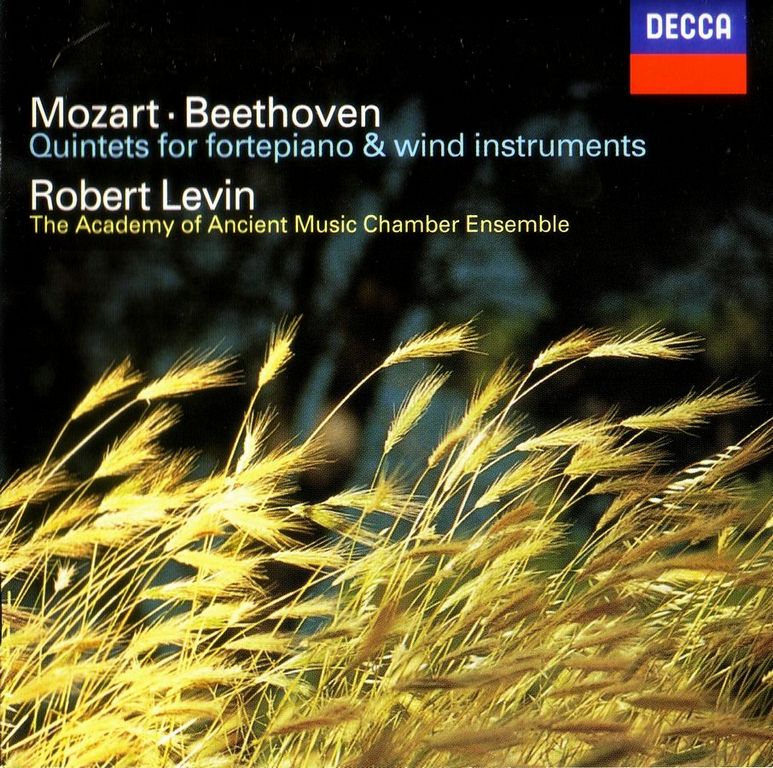
Mozart & Beethoven: Quintets for Fortepiano & Wind Instruments


Robert Levin and the Academy of Ancient Music Chamber Ensemble provide a look back through time. These pieces are now quite familiar to listeners who, for the most part, have heard them played with only contemporary instruments. Levin's fortepiano and the period instruments of the Ensemble give the music a much different feel. It seems fitting to a smaller room--a more intimate performance.


Mozart's Quintet for Fortepiano and Wind Instruments (K. 452) is structured much like a concerto and was one of the composer's own favorites. Levin and the Ensemble strive for consummate authenticity in performance, and the effort is well-rewarded.

The included Beethoven pieces may have similar orchestration, but the difference in style is apparent. They take on regal airs, contrasting with Mozart's lyrical serenity. Even with period instruments, Beethoven's compositions fill the room with sound, swelling with pride and enthusiasm.

Levin's reputation as a master of the fortepiano is well-earned. His performance is studied, yet full of personality. The Academy of Ancient Music Chamber Ensemble excels as well.

Thứ Tư, 26 tháng 9, 2012

Mozart: Overtures


“…Rinaldo Allessandrini… has an innate understanding of Mozart's conception of "sonata form" as concentrated drama. He also has an uncanny ear for sonority. Alessandrini makes the brass an integral part of the woodwind choir: hear how beautifully they are incorporated into the wind chords in The Magic Flute - just one of the vivid and thought-provoking details that make this such a delightful disc.” --Gramophone Magazine, October 2009


Norwegian National Opera Orchestra, Rinaldo Alessandrini

Naïve continues its collaboration with renowned conductor, Rinaldo Alessandrini, which sees him lead the Norwegian National Opera Orchestra in an exciting release featuring the overtures from Mozart’s greatest operas.

This is in fact Alessandrini’s first recording with an orchestra playing on modern instruments and resulted from Alessandrini’s position as Principal Guest conductor of the Norwegian National Opera that he’s held since 2005. He chose this repertoire as during his years in this position, it was the sublime music of Mozart that the Orchestra responded to best.

A virtuoso on the harpsichord, organ and fortepiano, and the founder and conductor of Concerto Italiano, Rinaldo Alessandrini is considered a major force in today’s international early music scene. He and his group have created new standards of excellence in the performance of 17th and 18th century Italian vocal music. Alessandrini’s desire to re-conquer the long-neglected madrigal repertory of the early seventeenth century led to the founding of the Concerto Italiano vocal ensemble. Norwegian National Opera Orchestra is one of Northern Europe’s oldest orchestras, dating back to 1827.


Thứ Hai, 17 tháng 9, 2012

Sonatas by Mozart, Liszt & Berg with Bartók's folk dances


“This richly varied selection of works...opens with probably the most powerful of Mozart's two minor-key sonatas and Grimaud's interpretation is suitably involved and full-blooded...Her ardour and romanticism are entirely suited to the Berg and Liszt Sonatas: the technical challenges are effortlessly overcome and the tonal architecture is clearly paramount.” --International Record Review, December 2010

“The Liszt Piano Sonata...is given a powerful and fluent reading that gets to the heart of the piece...skip the Mozart, sample the Berg and revel in the outstanding performance of the Liszt and the delightful Bartok.” --Classic FM Magazine, February 2011 ***


“The best is Bartók’s Romanian Folk Dances — a pungent coda” --The Times, 20th November 2010 ***

“Mozart's A minor Sonata comes through the Grimaud experience much the best. Her booklet interview gives an intriguing view of the composer...and her way of bringing out the music's dramatic, pre-Beethoven manner convinces strongly...In Liszt's Sonata she deploys her technical command with total fearlessness” --BBC Music Magazine, January 2011 ***


Thứ Hai, 10 tháng 9, 2012

Mozart: Concerto for Oboe and Orchestra

 
Albrecht Mayer began his career in 1990 as solo oboist with the Bamberg Symphony Orchestra. Two years later he received an offer from the Berlin Philharmonic and ever since, Albrecht Mayer has worked internationally as a soloist, playing with such masters as Claudio Abbado, Sir Simon Rattle, Nikolaus Harnoncourt, Iván Fischer and John Eliot Gardiner. His credo is: "I would like to inspire people to be enthusiastic about music".


Thứ Sáu, 24 tháng 8, 2012

Bassoon Concertos by Mozart, Haydn M., Stamitz & Weber


'A delightful and generous collection' --Gramophone

'Dynamic and expressive contrasts are carefully and adroitly created and the orchestra meticulously managed. The result is a lovely and technically superior recording, not to mention another star in the crown of the folks at Hyperion' --Fanfare, USA

'Dazzling. Hyperion's perceptive talent-spotting has produced a charming disc from performers virtually new to the catalogue – unreservedly recommended' --BBC Music Magazine


'a recording of airy clarity … a most recommendable disc, with much to enjoy' --International Record Review

'The playing of the Manchester Camerata (on modern instruments) is excellent throughout … They and their oboist conductor support their principal bassoonist with such care and attention that it is fair to call this a labour of love all round. Enjoy' --musicweb.uk.net

'The performances are all sophisticated … a pleasure to listen to' --American Record Guide